The Family Business
From Siete Family Foods to 7-Eleven, McCombs
entrepreneurs create family legacies in the business world.
Story by Sharon Jayson | Illustrations by Matthew Billington
The family farm may be the ultimate and once most-recognized family business, but family-owned enterprises in the U.S. today run the gamut from small companies to multinational corporations.
As Texas — like the rest of the nation — shifted from a dominant farm economy to a more diversified one over the last century, the McCombs School of Business evolved to meet new demands. With its emphasis on entrepreneurship, McCombs has embraced the importance of family
businesses and groomed hundreds, if not thousands, of family business owners since its inception 100 years ago.
Among the businesses are Adams Extract, one of the oldest food-flavoring companies in America, dating to the 1880s, and founded by the father of UT’s first BBA graduate, and a much newer one, Siete Family Foods. Siete was founded this century by three members of the Garza family, which hails from Laredo. All seven members of the immediate family are involved in running the company, which sells its food products around the country.
About 90% of American businesses are family-owned or controlled, according to the U.S. Census Bureau. Research suggests that many of
these businesses last only a generation, but some, such as Adams, endure
for several generations. One driver is the connection family members
feel with the business and with one another, prompting them to act in
ways that help their company thrive through the decades, according to research.
Although some believe family businesses are not as effective or as efficiently managed as nonfamily businesses, research at McCombs and elsewhere shows otherwise. Vijay Mahajan, a McCombs marketing professor and the John P. Harbin Centennial Chair in Business, compared
the performance of 148 publicly listed family-owned companies with 127 publicly listed nonfamily-owned businesses.
Mahajan’s study found that family businesses outperformed nonfamily
companies during the 2001 and 2008 recessions by being proactive.
“They want to preserve the company for the next generations. They have every incentive to make sure they do the best they can do and don’t compromise on the consumers,” he says. “They make sure — when introducing new products and promoting them — that they’re not cutting their budgets.”
Paul Green Jr., an assistant professor of management at McCombs, has been studying multigenerational family businesses for several years. He interviewed business leaders at 25 companies in the U.S. and Europe in 2017 and 2018 and says family-run or family-managed businesses — if they have outside board membership — tend to be more profitable and have
higher value than publicly traded companies of the same size.
“Family-run businesses, if they can last, outperform their public nonfamily businesses,” says Green. “In a true family business, there’s a broader sense of building a facility for multigenerational wealth building.”
However, he acknowledges that family businesses have high failure rates. For those companies that do become multigenerational family businesses, many identify closely with their town’s successes and take pride in being
leaders. The leaders of many such family operations are not only McCombs alumni but recognizable names in their communities.
In honoring the school’s centennial and those who learned here and thrived, here’s a closer look at five successful family businesses created
or transformed by McCombs alumni.
“If somebody is starting a business with family, they should heavily consider it, knowing that business is difficult, and family should be forever,” says Miguel Garza of Siete Family Foods.
All seven members of the Garza family are involved in running Siete Family Foods, which sells its food products around the country: (from left) Miguel, Rebecca Garza Cuellar, Linda, Bobby, Aida, Veronica, and Rob.
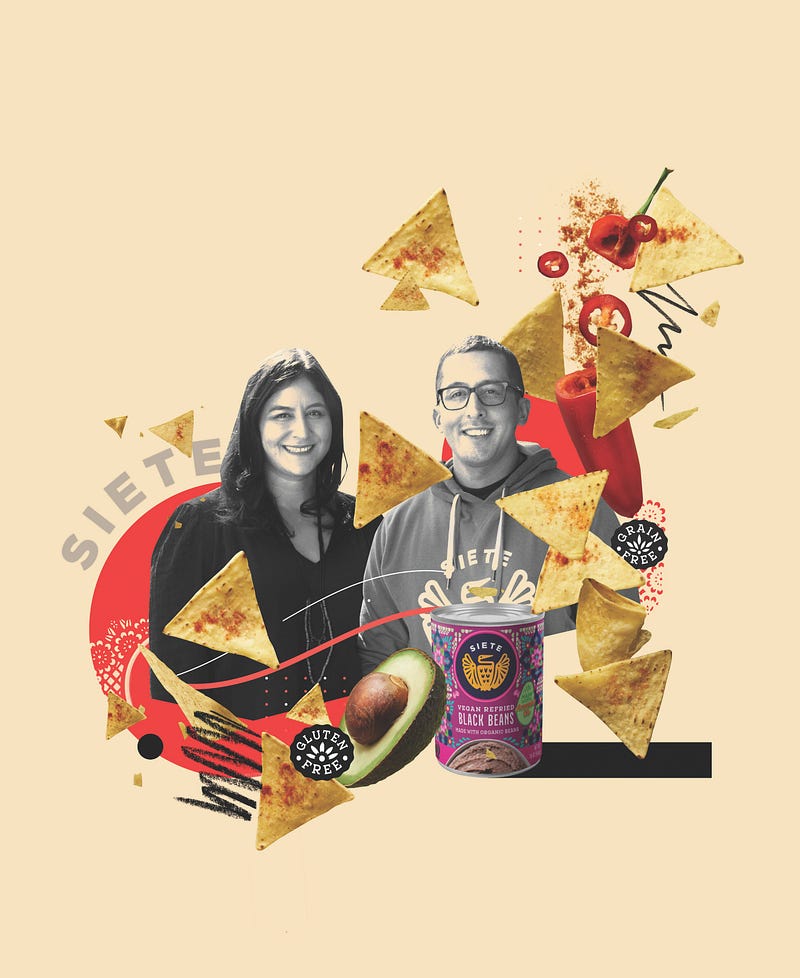
The Garza Family: At Siete Family Foods, It’s “family first, family second, business third.”
A family member’s illness forever changed the life plan of Miguel Garza, BBA ’09, J.D. ’12, and that of his seven-member family. His sister’s experience transformed the family from Laredo gym owners to creators of a nationally recognized Mexican American food brand.
Siete Family Foods — known simply as Siete on the label — specializes in making health-conscious foods without dairy, gluten, soy, or grain. It began in 2014 with just one item, an almond flour tortilla devised by his sister Veronica Garza, who had to change her diet because of a sensitivity to grain. Now, Siete’s products are stocked at 16,000 supermarkets in the U.S. and Canada, including H-E-B, Kroger, Whole Foods, Costco, Walmart,
and Target. Offerings include tortilla chips, taco seasoning, potato chips, churro strips, cookies, and enchilada sauces. The company’s
refried beans launched in April.
Miguel Garza, the brand’s co-founder and CEO, had planned to become a lawyer and return to his hometown of Laredo, where his family lived. Just like his parents and four older siblings, he moved to Austin to go to UT.
After Veronica, B.A. ’03, was diagnosed with three autoimmune disorders, she developed an almond flour tortilla out of necessity. That gave Miguel, a McCombs marketing major, an idea.
“I was walking through cafes in Austin and was fascinated by the idea that people were building businesses from behind a MacBook or PC and building multimillion-dollar enterprises,” he says.
“At the same time, I was getting acquainted with different individuals building food and beverage businesses. My sister had this product and was already selling it to family and friends and people at the gym,” he says.
“Because I was living in between those two things, it was easy for me to see how my sister could transform this product into a business enterprise. I distinctly remember telling her, ‘You are going to regret not doing this way more than you’ll regret giving it a try.’ ”
After graduating from McCombs, Miguel got married, stayed in Austin, and started thinking of a career beyond practicing law.
Today, Siete has a 100-person team, but the original seven family members inspired the name Siete. It means seven in Spanish and represents Miguel, along with Veronica as co-founder and company president; their father Bobby Garza, BBA ’76; mother and co-founder Aida Garza; and three siblings, Linda Garza, B.J. ’97, Rebecca Garza Cuellar, B.S. ’06, M.A. ’08, and Rob Garza. All seven left Laredo and now live in Austin, where they get help running the business from in-laws, extended family, and nonfamily members.
Miguel Garza credits McCombs for developing his creativity, as well as skills in collaboration and presentation, especially creating a mock business for Stephen Walls’ marketing class.
“In hindsight, I was pretty set that I was going to become a lawyer and, therefore, I think I was going through business school to learn as much as I could, only for the sake of learning,” he says. “But when I look back now on Siete, when you are put into a school where everybody is trying to develop and get better and learn, it really just sharpens you as an individual. I was
lucky enough to be surrounded by super smart people, so the collaborative learning was even a bigger deal because I was learning from peers.”
When Siete was just 3 years old, in 2017, Miguel was named to the list of Forbes’ 30 Under 30. In 2021, Siete surpassed $200 million in retail sales.
Garza says his family’s business has faced the same challenges as any with multiple stakeholders. But he says for the Garzas, it’s “family first, family second, and business third.”
“When I look at how the family played a role, it’s almost hard to think about how it would have been possible without the family,” he says. “If somebody is starting a business with family, they should heavily consider it, knowing that business is difficult, and family should be forever.”
Although the gym operated from 2009 to 2016, when the Garzas sold it, that family business prepared them for their next venture, based on another Garza family value: “Together is better.” It’s also the Siete motto: “Juntos es mejor.”
“It makes it that much more rewarding because you’re doing it together,” Miguel says.

The Broadus Family: Founder’s wife and daughter carry on legacy of service at Commonwealth Computer Co.
When William Broadus, BBA ’71, MBA ’74, was about to launch a technology sales company in 1995, he enlisted his daughter’s help for
what would become a multigenerational family business, with both
generations educated at McCombs.
Nikole Vaughn, then a McCombs undergraduate, remembers helping her father research company names during a trip home to San Antonio. Vaughn and Broadus carefully vetted the possibilities with the help of an encyclopedia — eventually landing on “Commonwealth.”
“It meant access for all … for all ‘common’ people to have access to wealth,” says Vaughn, BBA ’96, MSTC ’04, now executive vice president of Commonwealth Computer Co. “He wanted his company to do just that.”
Broadus, who worked at IBM Corp. for 17 years after graduating from McCombs, helped equip some of the earliest school computer labs
during the 1980s. After founding Commonwealth Trading Company Inc., doing business as Commonwealth Computer Co., he quickly established it as the go-to reseller of hardware, software, and technology services for governments and schools. The company’s clients include several State of Texas agencies, Bexar County, the City of San Antonio, The University of Texas at San Antonio, multiple Texas A&M University System campuses, and K-12 schools.
After Broadus’ death in 2013, his wife and company Vice President Karla Broadus — who has a background in education, including as a reading teacher, school vice principal, and professor — took over as president. She also kept her faculty post at UT San Antonio until 2020 after more than two decades, most recently as the director of its African American Studies program. She still consults with the program but now focuses mainly on the family business.
“We really strive to be a value-added reseller,” Karla Broadus says. “We want to serve you from your first thoughts of buying a system through the sales to the receipt or installation (of the system), and then if you need assistance afterwards, come to us.”
Business has picked up in recent months as technology events resume in person. Broadus and Vaughn say they are cultivating several new clients.
Both say the roots of the company’s success go back to UT Austin — which not only laid the foundation for William’s successful career but is also where he and Karla met during the 1970s. William had already completed a
master’s degree and moved to San Antonio when a mutual friend introduced him to Karla, then an admissions counselor at UT Austin.
“One of the mottos of The University of Texas is, ‘What happens here changes the world,’” says Vaughn, who met her future husband,
LaSalle, BBA ’96, while they were both undergraduates at McCombs. “And that’s literally what we’ve seen in our own lives.”

The Thompson Family: At 7-Eleven, sons following dad’s example created an iconic worldwide brand.
Southland Ice Co. of Dallas, which sold blocks of ice before refrigerators
were ubiquitous, evolved into the company that would become the
world’s largest convenience store retailer, 7-Eleven, thanks to founder Joe
C. Thompson Sr., BBA 1922, and his McCombs-educated sons.
And, wouldn’t you know it, ice is still sold at 7-Eleven and remains an
essential ingredient in its iconic frozen drink, the Slurpee. The company,
now in 18 countries, with 81,000 stores, is known for its innovative
moves: offering to-go coffee cups, having a self-serve soda fountain, and
keeping its doors open 24/7.
Though no longer family owned or operated, 7-Eleven still reflects Thompson’s entrepreneurial spirit and philosophy.
Joe C. Thompson, namesake of the Thompson Conference Center on the UT campus, had three sons who followed in his footsteps: John, BBA ’48, now deceased; Jere Sr., BBA ’54; and Joe, BBA ’62, called “Jodie” like his dad. All earned UT business degrees, joined the same fraternity their father did, and were managers of the football team.
Such family closeness was noted in a 1987 New York Times article, which says, “The Thompsons have managed to run their holdings without the family arguments that have plagued other wealthy clans.”
Jere Thompson put his children to work in the business, beginning in elementary school. They rode bicycles to the store and “started out at a nickel an hour and then 10 cents and then a quarter,” he says. “They learned real life and how you greet customers.”
By 1964, national expansion was rolling. “We learned how to franchise,” Thompson says. “Unions wouldn’t unionize a family, so that idea allowed us go to Washington, D.C., where John was stationed during World War II.”
Thompson says he called on business skills he developed at UT to make 7-Eleven thrive.
“When running the Florida branch, the thing that helped me most was business law,” he says. “It helped me understand how to acquire property.”
Another 7-Eleven executive and McCombs graduate, Marissa Jarratt, BBA ’99, MBA ’04, continues the family’s tradition.
The founder Joe C. Thompson’s mark is ever present, says Jarratt, chair of the McCombs Advisory Council for the Master of Science in Marketing program and a McCombs Business Hall of Fame Rising Star.
“His famous quote that we refer to at 7-Eleven is ‘Give the customers what they want, when they want it, and where they want it.’ Ninety-four years later, our corporate vision is inspired by his guiding principle,” she says.
Although the family sold its interests in 1992 to Ito-Yokado, a Japanese retail chain that reorganized to become Seven & i Holdings Co. Ltd., 7-Eleven’s headquarters is in Irving. As the company’s chief marketing officer and executive vice president, Jarratt credits her MBA in marketing and Professor Julie Irwin with shaping her career.
“An icon in the industry, she ignited my passion and intellectual interest in consumer behavior, which is a foundational element of being a marketer,” Jarratt says.
That inspiration resonates in Joe C. Thompson’s long-ago challenge, which Jarratt summed up as: “Be the first choice for convenience anytime, anywhere.”

Leon and Tiffany Chen: For Tiff’s Treats husband-wife founders, first came an apology, then a big idea.
Leon Chen, BBA ’01, wasn’t planning to start a business when his then girlfriend-and-now-wife Tiffany delivered a peace offering for standing
him up on a date. That little batch of just-from-the-oven chocolate chip
cookies inspired a big idea that Chen, a sophomore marketing major,
couldn’t shake: Who wouldn’t love a warm-cookie delivery?
Tiff’s Treats was born that year, in 1999. The company the couple
started in his Hyde Park apartment and turned into a business worth
over $500 million with more than 80 locations in Texas and beyond has
UT ties throughout. “I took some management classes,” Tiffany Chen,
B.S. ’01, says. “ Leon’s business foundation was really helpful.”
For its first decade, the Tiffany of Tiff’s Treats baked the cookies herself.
She made the dough with a handheld mixer for almost two years
until she got an industrial mixer. That was a game changer, she says.
Tiff’s first corporate order came from a UT department. “That’s how much and how important the university was to the success of our business,” Leon says, noting how fortunate it was to have early investors with strong UT ties, such as businessman Steve Hicks, a member of the UT System Board of Regents. “There is this Texas connection and always has been.”
Investors include a host of well-known Austin-based fans, including jewelry designer Kendra Scott and the husband-wife duo of tennis champion Andy Roddick and model-actress Brooklyn Decker.
“At first, it was about 15 hours a week on the business,” Tiffany says. “By the time we graduated, it was 40 hours a week on the business.”
“We were wildly jumping off a ledge and 100% learning on the fly,” Leon says. Sometimes they learned through failure: A Sixth Street walk-up
location in Austin flopped. But most of their ideas succeeded, including being early adopters of online orders.
“We both got our first email addresses at the University of Texas orientation,” Leon says, referring to a then-new technology that would become so important to their business. “My introduction to software and computers was at The University of Texas freshman year.”
What he learned at McCombs encouraged the couple to invest in a proprietary technology so that almost all orders are digital, long before
online food orders became common.
Now, the couple oversee what has become a Texas staple and is growing beyond its borders. With almost 1,900 employees in five states, the
company will open in two new states, Colorado and Florida, this fall.
The couple do not franchise Tiff’s Treats.
“We want full control over how we build that brand and experience,” Tiffany says. “As we’re introducing ourselves into more and more areas, we want to be the owners of the full customer experience.”
Leon says they often hear from customers about the special connection they have with the company. “At the end of the day, what sets us apart is that the cookies are the conduit, but it’s the experiences and the moments that people were counting on from us.”
Whether Tiff’s Treats becomes a multigenerational family business depends: The couple’s twins are only 7.
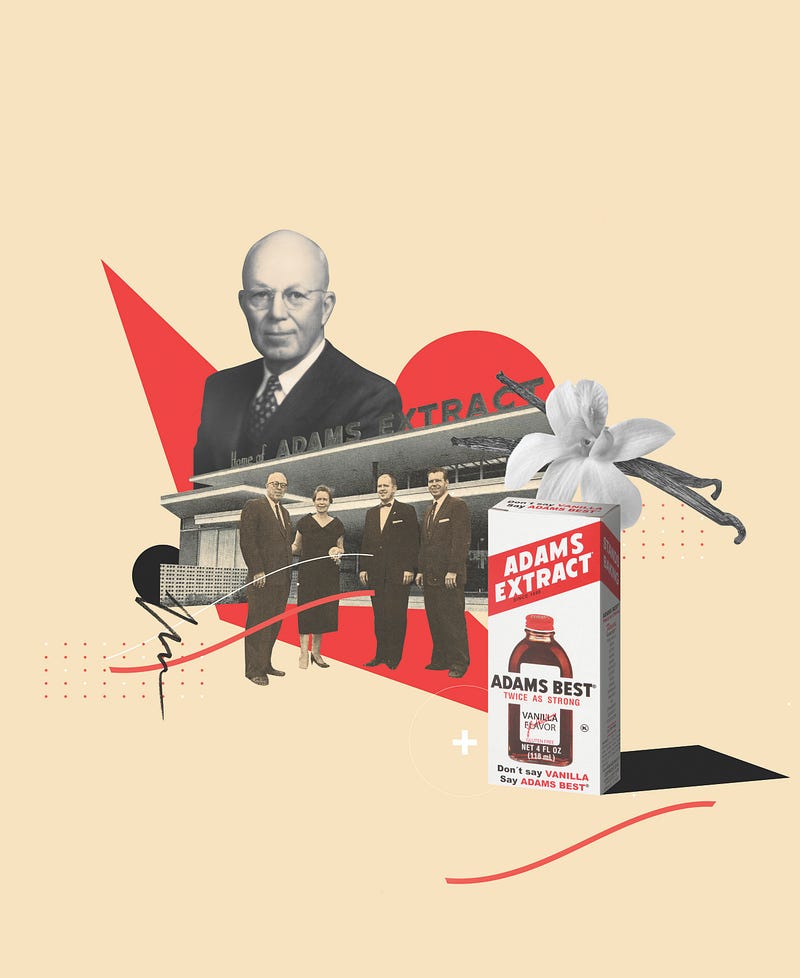
The Adams Family: Adams Extract became a kitchen staple, thanks to UT’S first BBA grad.
Fred Adams isn’t a household name. But Adams, the first University of
Texas BBA graduate — in June 1917 — used the knowledge he gained at UT to
create an enduring national brand still found in countless U.S. households.
Now called Adams Extract & Spice and based in Gonzales, about 70 miles
east of San Antonio, the company is one of the state’s oldest continuously
operated businesses. Its roots reach back to 1888, when Fred’s father, John,
founded a vanilla-flavoring company in Battle Creek, Michigan.
Wanting to create a vanilla extract his wife could use in baking, John
Anderson Adams began making and selling Green Plant Sarsaparilla
extract called Adamur with just $6.71 worth of materials, according to the company’s website. At the time, vanilla was sold to pharmacies and labeled “Do not bake or freeze.” His wife, Grace, found her husband’s concoction perfect for baking and declared it “the best flavoring I have ever used.”
Adams’ sons Fred and Don helped print labels and bottle the product, selling it door to door. In 1905, the family moved to Beeville, Texas,
where the company grew. In 1922, Fred bought the business from his father and moved it to Austin, where he built a two-story building downtown. The company website claims the red food coloring it created popularized another new product, red velvet cake.
In 1955, Adams built a production facility on Interstate 35 that helped product expansion, including a full spice and seasoning line in 1959.
Under Fred Adams’ second-generation leadership, the company thrived, and his son grew up working in the business. That son, John G. Adams, also went to UT, earning a bachelor’s degree in chemistry and designing the four-pack food coloring still sold today.
Today, the company makes hundreds of products and flavorings. It remained a family-operated business until a group of San Antonio
investors bought it and moved operations from Austin to Gonzales in 2002. In 2012, Valesco Industries, a Dallas-based private equity firm, bought the business.
Company President and CEO Dan Shannon, one of the investor-owners, says Fred Adams “was a true innovator.”
“If not for World War II, he would have moved the business nationally,” Shannon says. “He invented a lot of things. He brought the modern-
day recipe for red velvet to the nation. He invented butter flavor, when in World War II, they rationed butter.”
Shannon says Adams also was an innovator in cross-marketing. “If you bought Pioneer Mills flour or a bag of Imperial Sugar, there was a high
likelihood it had an Adams coupon,” Shannon says. “He was just a smart guy. Fred Adams drove many of the advances in the company that the
business today was built on.”
Sharon Jayson, an Austin-based journalist, is a former staff reporter for USA Today and the Austin American-Statesman. Additional reporting by Alice Popovici.
This article appeared in the Centennial 2022 issue of McCombs magazine. Click on the link to see the full issue.
About this Post
Share:

![Jovon 00059[10]](https://news.mccombs.utexas.edu/wp-content/uploads/2026/10/Jovon_0005910-600x400-1.jpg?v=1791229930)