Too Many E-Scooters? Blame Competition
Companies littered sidewalks by chasing market share instead of profits
Based on the research of Ashish Agarwal, Kumar Muthuraman, and Ioannis Stamatopoulos
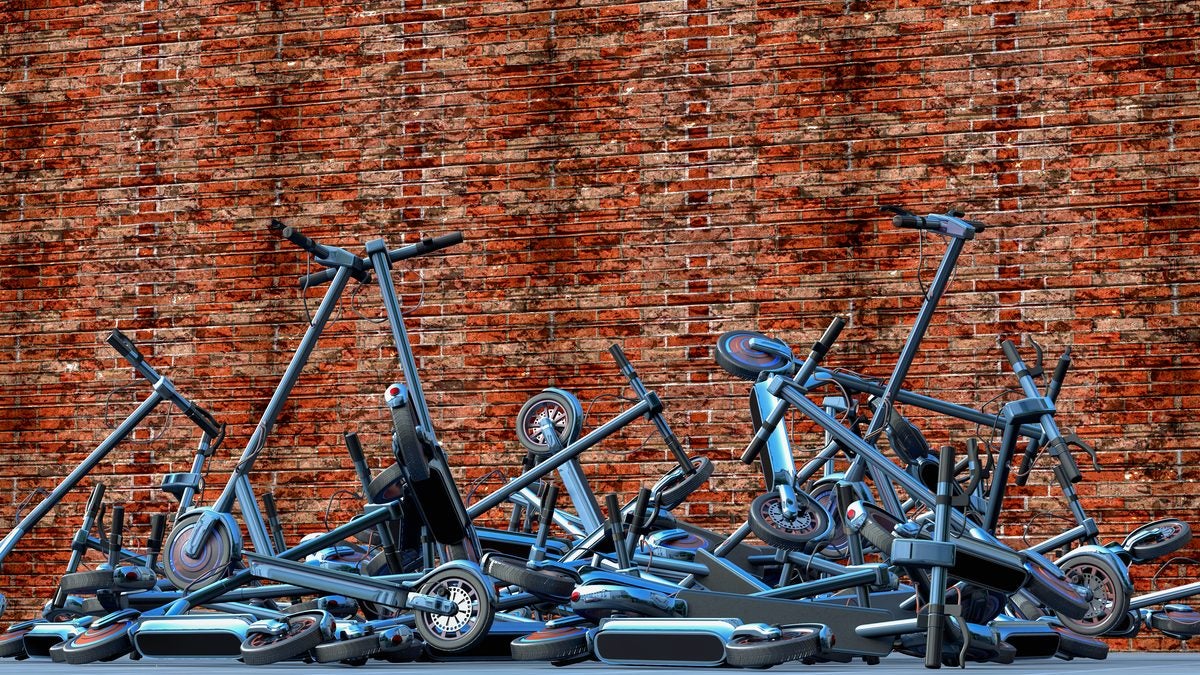
In 2018, something strange happened on sidewalks across America. In 65 cities, thousands of electric scooters appeared seemingly overnight, often with little or no advance notice to local governments.
Cease-and-desist orders flew. Scooters were impounded. Even after cities imposed regulations, there seemed to be far more scooters than anyone could ever use.
New research from the McCombs School of Business at The University of Texas at Austin finds that the excess was no accident. Scooter companies had deliberately baked it into their business models. The findings provide new ammunition for local governments seeking to keep the numbers down.
McCombs professors Ashish Agarwal and Kumar Muthuraman and associate professor Ioannis Stamatopoulos — all of the Department of Information, Risk, and Operations Management — examined ridership and scooter deployment data from nine U.S. cities and more detailed data from Kansas City, Missouri. Leading the research team was McCombs doctoral student Hale Erkan, now at Arizona State University.
They concluded that micromobility companies such as Lime and Bird, providing nearly identical services, intentionally oversupplied scooters between 2018 and 2021.
The key evidence was daily scooter utilization rates. For local policymakers, the average target utilization was 7.7%. But the actual rate for the nine cities turned out to 3.6%, which meant on average 96.4% of scooters were sitting idle.
“Scooters operate in the public right of way, and they can put almost infinitely many scooters on sidewalks,” Erkan says. “Sometimes, there used to be hundreds of scooters on the same street corner.”
Market Share Over Money
Why did companies invest in so many unused scooters? The chief reason, the researchers say, is that during their early years, they weren’t trying to turn a profit. Backed by venture capital, their goal was to capture market share, giving them every incentive to flood streets as fast as possible.
“Profitability was not the aim,” Stamatopoulos says. “It was showing they were the biggest player.”
Irrational as that might sound, the researchers found that oversupplying scooters, rather than building brand loyalty, was the most effective tactic providers could take.
The data revealed that regular riders chose vehicles mostly at random, and that they tended to have multiple micromobility apps on their phones. If someone looking for a scooter approached an intersection that had nine Lime scooters and one Bird scooter, Lime had about a 90% chance of getting picked.
That dynamic gave every company a rational incentive to deploy more scooters than demand required. They didn’t expect all the vehicles to be ridden. They wanted to capture the next customer.
“The companies don’t inherently want to oversupply scooters,” Stamatopoulos says. “But due to competition and customer choice behavior, if they don’t, they’ll get overcrowded and lose market share.”
In Kansas City, the researchers found the combination of rider choices and competition had ballooned an optimal fleet of 188 scooters to 1,188 — a 531% oversupply. Adding another operator would have pushed the excess to 613%.
Culling the Two-Wheeled Herds
For cities that want to take back their sidewalks, the researchers’ prescription is to limit the number of operators they permit. Two companies should suffice to keep prices competitive and spur innovation.
“Any entry after two firms only contributes to the oversupply problem without benefiting anyone,” Erkan says. “The easiest solution is to cap the number of firms, and because scooters are fully regulated by city transportation departments, no other level of bureaucracy is needed.”
Cities could also penalize operators for low utilization rates by monitoring usage in real time and fining companies that fall short of thresholds, she adds. A city-mandated ceiling would give every operator the cover to pull excess vehicles without fear of being undercut.
To some extent, the market has already moved in that direction, Stamatopoulos notes. During the five years since the study period, the industry has shrunk through mergers and bankruptcies. Where a dozen companies once competed in cities such as Austin and Chicago, only a handful remain nationally, and utilization rates have improved.
“Competition sounds good,” he says, “but actually, competition can lead to pollution. The ideal is to have some competition — but not too much.”
“Competition for Customer Attention Is Creating Oversupply Pockets in US Micromobility” is forthcoming in Operations Research.
Story by Kiah Collier
About this Post
Share: