Texas Can Strengthen Key Supply Chains, McCombs Professor Tells Legislature
Mapping supply chains, training workers, and creating an incentives clearinghouse can make the state less vulnerable and more competitive

In recent years, businesses have learned that a supply chain is only as strong as its weakest link. Bottlenecks and failures have threatened supplies of gasoline, fertilizers, cars, pharmaceuticals, and electronics components.
How can Texas strengthen critical supply chains and make itself less vulnerable to disruptions? Edward Anderson Jr. of the McCombs School of Business at The University of Texas at Austin has several ideas.
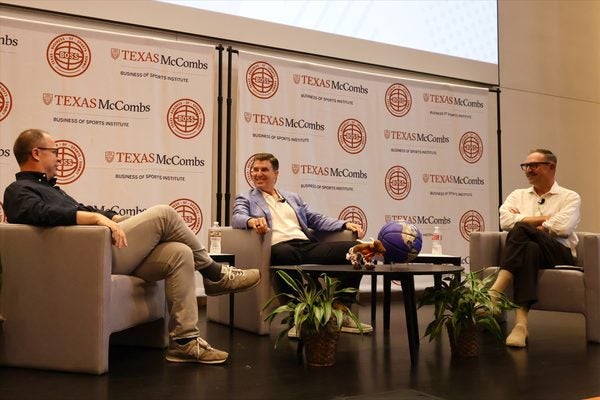
On Aug. 26, Anderson — professor of information, risk, and operations management and the Betty and Glenn Mortimer Centennial Professor in Business — testified about supply chain resilience to the Texas House Committee on Trade, Workforce & Economic Development. In this interview, edited for length and clarity, he outlines steps Texas can take.
Q: How long have supply chains been less secure?
Disruptions have picked up since about 2015: weather issues, trade conflicts, labor shortages, strikes, and so on. At first, the increasing slope of disruptions was rather slight. Then came the pandemic.
Afterwards, everybody thought things would go back to normal. Instead, we’re still seeing far more disruptions than we’ve had in the past, and it’s going to stay that way for the foreseeable future.
Q: What’s behind the increase?
One reason is parts complexity. One manufactured part may have a dozen parts that come from suppliers. Each of those may have a dozen sub-suppliers. A lot of supply chains, from manufacturing to raw materials, are seven, eight, 10 tiers deep.
Let’s talk about cars. The immediate suppliers to an automobile make engines. With an engine system, you have electronic controllers. Every one of those has sub-suppliers, including chips, resistors, and so on. It just keeps going.
If you’re missing any one of those parts, you’ve got a problem. That brings us to geographic and supplier concentration. Taiwan Semiconductor is the only maker of leading-edge chips in the world. There’s only one company that produces the equipment for them, and that’s in the Netherlands.
Similarly, there are certain drugs that are only produced in a handful of plants, or even a single one in China or Germany. This is especially true for generics, including cancer drugs.
Q: How can we make supply chains more resilient?
There are a bunch of things we could do in Texas, although you really ought to consider the entire United States.
One remedy is mapping supply chains to make invisible connections visible. Nobody actually knows where the sources of a lot of disruptions occur. If you map down only a couple more layers, that gives you a lot of advance warning.
We’re doing some of this right now with the nuclear supply chain, because Texas wants to become a cluster of excellence there.
Q: What else can Texas do?
There’s geographic diversification, getting parts made in multiple regions. Lately, some production from China has been moving to India or Vietnam.
Mexico would be a nice destination for some of this production. Here in Texas, a lot of our attractiveness to business is being the gateway to Mexico and all those plants that are within a couple of hundred miles of the border.
We could bring some reshoring into Texas, too. We’ve got a business-friendly environment and Gulf Coast port access, and these days, the fact that we’ve got not just cheap energy but secure energy.
We have exposures, too. For example, because Texas has so much population and economic growth coming in, our grid is not as stable as it could be. We’re competing for business with states like Ohio, Tennessee, Virginia, and South Carolina.
Q: How do those states compete with Texas?
In general, they all have some kind of coordinated state industrial policy with respect to bringing in manufacturing and supporting it.
Texas really doesn’t. We have lots of support for industry, but it tends to be fragmented. There are all these incentives at the municipal level, and there are all these universities, and we have some workforce programs.
It would be nice if we had some sort of agency to put all that information at a single point of contact. We could reduce search costs for new or relocating businesses through a one-stop shop for Texas capabilities, incentives, sites, and suppliers.
To be fair to the state, they’re moving towards that in a couple of clusters, particularly electronics and semiconductors.
Q: How do workforce programs help make us competitive?
We need skills training that’s aligned with supply chain gaps. There’s a large labor shortage in the U.S. with respect to skilled trades, such as welders, electricians, and tool makers.
Even so-called unskilled trades really aren’t unskilled anymore. A lot of companies like Tesla are giving them more training in math, how to read graphs, and technical things directly related to their industry. Those are things that the state can work on to make us more attractive to business.
Q: What can legislators learn from The University of Texas about supply chains?
We teach this stuff and understand it quite well at a framework level. Most of the people who testify in front of them have an agenda, like an industry association. We can help state officials by giving them some unbiased feedback and unbiased information.
Story by Steve Brooks
About this Post
Share:
![Jovon 00059[10]](https://news.mccombs.utexas.edu/wp-content/uploads/2026/10/Jovon_0005910-600x400-1.jpg?v=1791229930)