AI: Not Always a Team Player
Artificial intelligence tools can boost individual achievement but hamper organizational learning
Based on the research of Edward Anderson
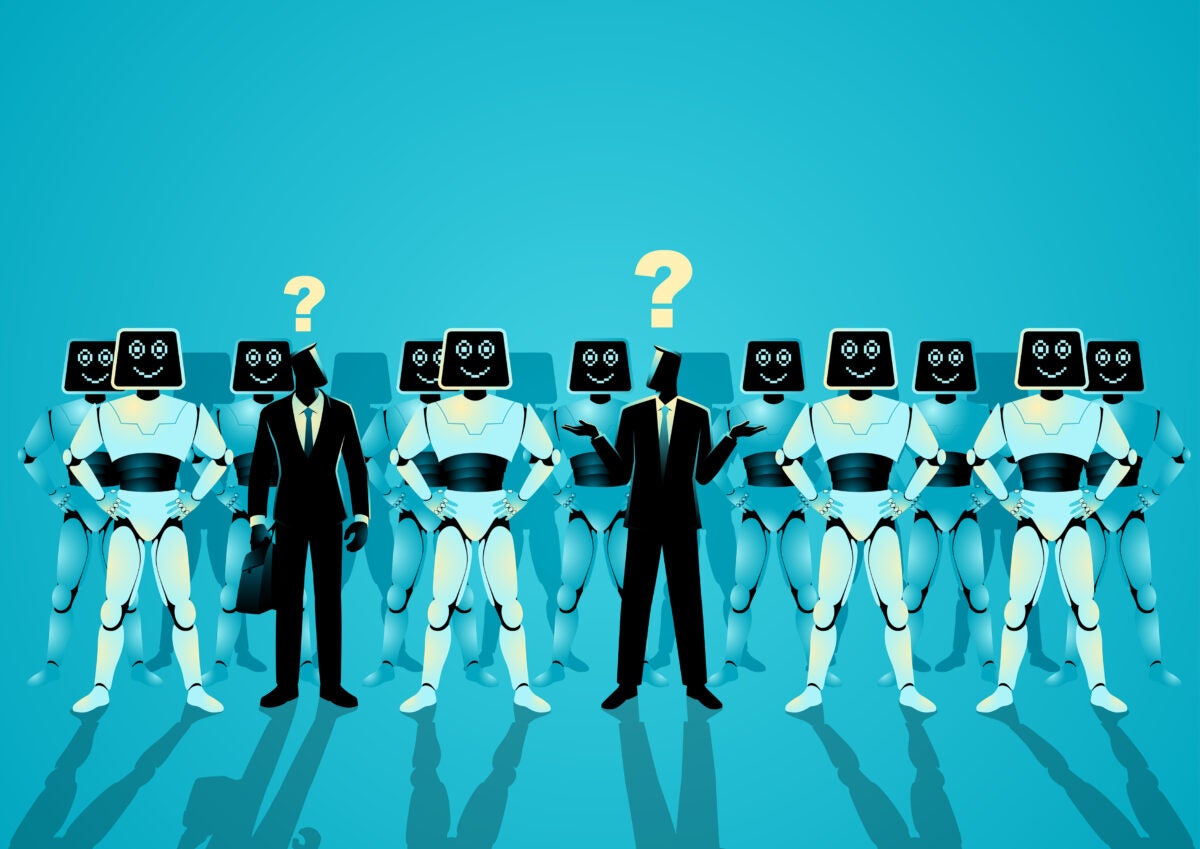
Using artificial intelligence tools can make individuals more productive at work. AI can enable faster and more informed decisions. It can automate routine tasks, freeing employees to tackle more complex projects.
But most businesses are built on teams. They function as hives for collaborating and sharing disparate knowledge. As AI gets increasingly embedded in the workplace, is it an asset or a hindrance to the collective knowledge teams produce?
New research from the McCombs School of Business at The University of Texas at Austin finds it can be both. AI boosts team learning in the short term but can lead to long-term decline.
“If you bring in AI, it’s going to have implications for how teams coordinate and develop a shared vision with what they’re trying to do with their work,” says Edward Anderson, professor of information, risk, and operations management and Betty and Glenn Mortimer Centennial Professor in Business.
“Without a stock of collective knowledge, individual learning slows, which reduces the overall performance of the system.”
Performance Boost to Bust
With Patrick Figge of the University of Passau, Germany, and Kyle Lewis of the University of California, Santa Barbara, Anderson ran a series of computational experiments.
Based on the previous work with software engineering teams, the experiments modeled an AI-human learning system: how individual, collective, and AI knowledge interact over five years. Under a typical set of parameters, the simulations found:
- AI initially made teams more productive by increasing individual and collective learning. Teams increased their productivity by a factor of 12.5 — more than they could achieve without AI.
- But performance declined after only six months. Three years later, team productivity was only three times what it had been initially — a fall of 75% from its peak.
Why the sharp dropoff? A central cause, the study found, was a failure to communicate.
On effective teams, Anderson says, individuals understand both their own jobs and the joint task. But communication can break down when people hone deep specialties in different areas.
In the simulations, AI helped individuals perform better as they focused on their individual jobs, which enhanced team learning in the short term. Eventually, however, team learning worsened. Collective knowledge dropped below collective forgetting after five weeks.
“Individual team members become so specialized that after a while, they have trouble poking their heads above the weeds and talking to others on the team about what they’re doing,” Anderson says.
“Shared understanding of the project starts deteriorating, and team productivity starts declining.”
Tool or Team Member?
Beyond performance, the rise of AI agents — programs that autonomously execute specific tasks — is prompting broader questions about the very nature of teams, Anderson says.
“Some of the people we’ve spoken to in the software field refer to agentic AI as ‘AI with CVs,’” he says. “They’re starting to look more like people and in a way becoming team members.”
For example, junior engineers, who previously focused on one task for a long period, may now manage multiple agents running multiple jobs at once.
Teams of the future could look different from today’s teams, he adds. Some possibilities:
Complicating individual jobs. As agentic AI becomes more powerful, individuals will be asked to take on new duties — such as managing multiple agents at once — for which they might not be ready. Says Anderson, “If individuals are having problems managing their agents, that’s going to create problems at the collective level.”
Smaller teams with bigger reach. Instead of the “two-pizza team” of five to seven individuals, a team might have three or four people — each of whom manages three or four AI agents.
“Managing what used to be a team might effectively be managing a department now,” Anderson says.
Synchronizing teams. Managing the collective vision will require breaking down silos to boost group learning, he says. Teams might spend more time in meetings. Or duties might be shuffled periodically to get people out of specialty rabbit holes.
The lesson, Anderson says, is this: As companies require individuals to use AI tools, they should pay attention to how teamwork might suffer.
“Because collective and individual learning are intertwined, each depends on the other,” Anderson says. “Our research shows that AI makes managing that collective vision and understanding what team members are doing more difficult.”
“AI-Human Learning Systems: Investigating the Strategic Role of AI for Organizational Learning” is published in Strategic Organization.
Story by Sally Parker
About this Post
Share: