The GreenLink
Hildebrand MBA student part of winning team in prestigious land use design competition
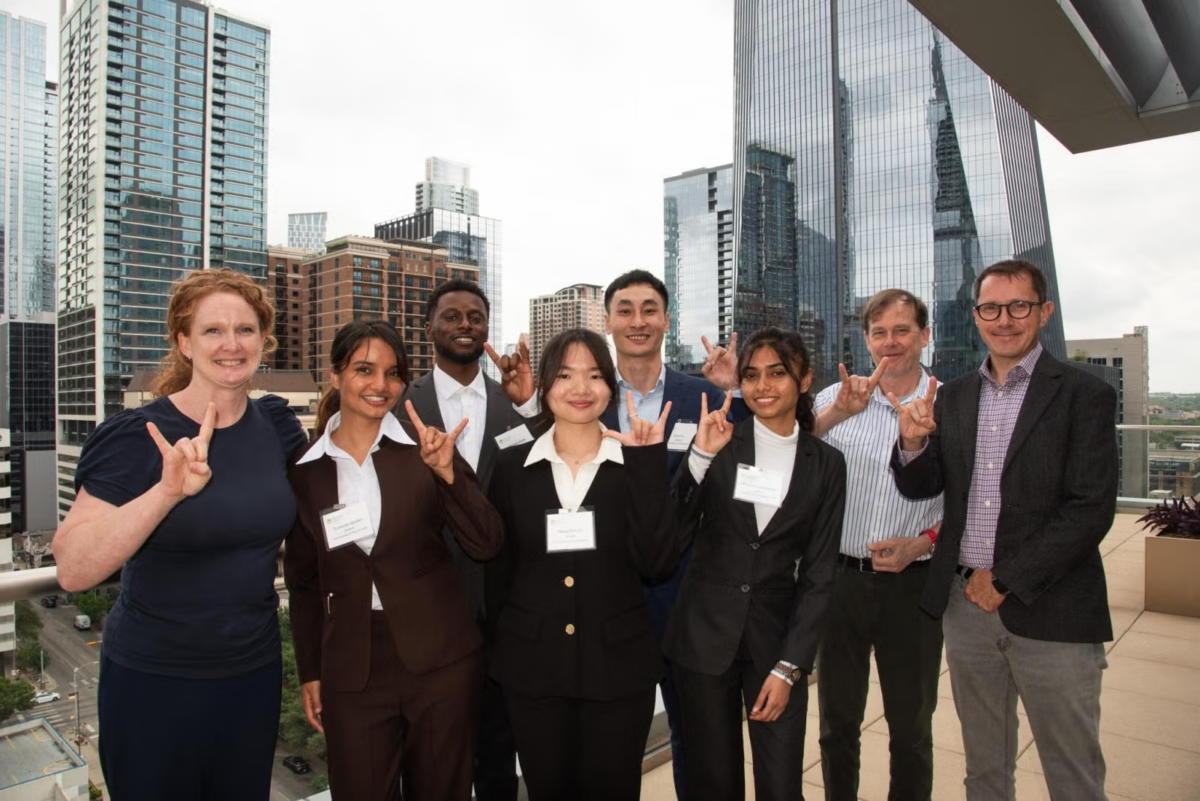
A team of University of Texas at Austin students in the McCombs School of Business and the School of Architecture placed first in an international land use design challenge that comes with a $35,000 prize for the winning team. It was UT’s third win, having won in 2017 and 2022.
Josh Hu, a Hildebrand MBA student at McCombs, played the finance role on the UT team in the 2026 Urban Land Institute’s prestigious Hines Student Urban Design Competition-Americas. The team was selected from 79 entries by graduate students from three dozen schools.
The annual competition—which also is held in Europe and Asia—gives students in design, architecture, urban planning, and finance an opportunity to tackle a real, large-scale land use challenge in a North American city from a developer’s perspective.
This year’s competition asked students to re-envision land containing Hancock Center, a shopping mall adjacent to Interstate 35 about three miles north of downtown Austin. In multidisciplinary teams of five, students acted as developers, producing comprehensive proposal packages with thematic designs and other visuals, narratives, and detailed spreadsheets showing market feasibility and other data.
UT’s GreenLink project would transform the area into a multiuse neighborhood featuring affordable housing, a medical corridor, retail, sustainable infrastructure, and green space linking it all together. It would physically reunite divided neighborhoods while also complementing functions that already exist in the surrounding area.
Woven around a theme of wellness and healing, it aims to advance the city’s strategic goals for equitable access, environmental resilience, and urban growth.
With a $900 million budget and 10-year rollout, Hu’s financial analysis was critical to the project’s viability. “I needed to detail multiple financial budgets, operational cash flow, and expected profit to make sure this mixed-use project with this time horizon is feasible,” Hu says.
Elements of the project would be rolled out in phases, beginning with rental apartments, a grocery store and hotel, and green infrastructure. Phases 2 and 3 would add more rental residences, office space, retail, and a community club. Not until phase 4 would for-sale townhomes be added.
“Austin has a severe housing affordability issue,” Hu notes. “From the demand side, the purchasing power is not strong enough to push the market further. So, once the functionality of the community is established, the market value of the townhomes will boost up.”
The competition was Hu’s first experience designing the phasing strategy of a big real estate project. He was tasked with allocating capital wisely, structuring debt and equity, and generating synergy between different businesses.
“This competition helped me to know who I am and what I’m really good at,” he says. “It was a truly eye-opening experience for me. That’s what I was lacking before the MBA. I really enjoyed it.”
For Hu, who worked in real estate investment for six years before pursuing an MBA, the competition confirmed his interests in the sector. But it also made him see real estate from another angle. Collaborating with designers and architects broadened his understanding of project development.
That is one of the aims of the ULI competition: to encourage teamwork and cooperation among future professionals from different disciplines in the planning, design, and development of places. Hu is now aiming to pursue opportunities on the development and execution side.
The experience also broadened his social network, Hu adds.
“Before the competition, we were totally strangers. We didn’t know each other. But after the competition, I have four more friends.”
Along with UT, finalists included two teams from Columbia University and a joint team from Harvard University and the Massachusetts Institute of Technology. The four teams refined their proposals and prepared presentations that they delivered before a jury of architects, designers, investors, and developers.
At least 12,260 students on over 2,452 teams have participated in the ULI competition since its first year in 2003, including 480 students on 92 teams who have made it to the finalist round.
Story by Sally Parker
About this Post
Share: