History Offers Warning on Dollar and Deficits
Economic fallout could be severe if the U.S. dollar falls from dominance as the world’s reserve currency
Based on the research of Mindy Xiaolan
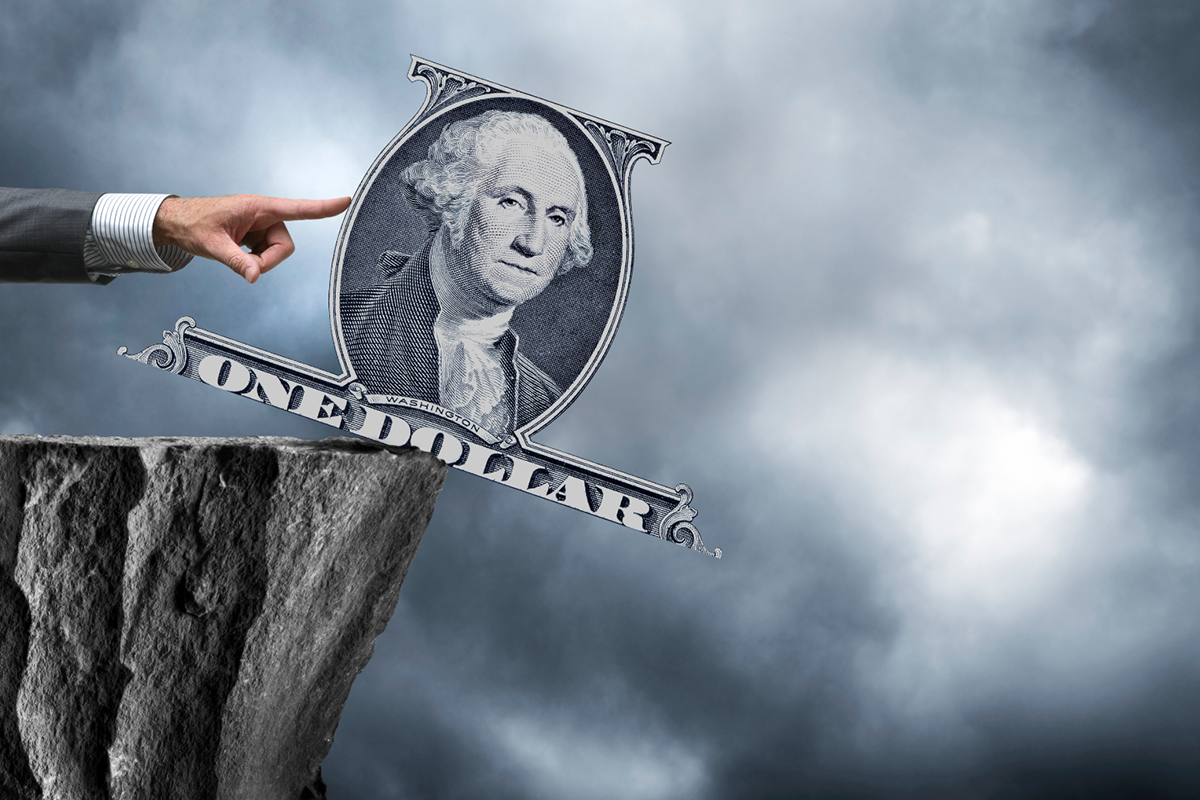
It’s no secret that Uncle Sam has been living beyond his means. During the past 25 years, U.S. national debt as a percentage of gross domestic product has almost tripled to 98%, according to the Congressional Budget Office. It’s projected to hit 166% by 2054.
The U.S. government has been able to run up that debt, in part, because investors around the world are still willing to buy its IOUs. Last year alone, the U.S. Treasury auctioned off $28 trillion in securities.
But investors may not always be so willing, according to new research from Mindy Xiaolan, associate professor of finance at Texas McCombs. She finds the U.S. government’s fiscal capacity — its ability to raise money — depends on the dominance of the U.S. dollar. Dollar-denominated assets make up 57% of global currency reserves, and dollars are used in 88% of foreign exchange transactions.
Her research highlights potential losses U.S. government bondholders could face if another currency ever replaces the dollar as the global reserve currency. The federal government might have to face significant fiscal adjustments, while investors in U.S. Treasury bonds could take a bath.
“When a country’s fiscal fundamentals deteriorate, and their currency loses its privileged status, its government’s borrowing capacity may become limited,” she says. “The market value of its debt will be lower, and the bondholders will suffer losses.”
Whether such consequences could strike the U.S. is “a trillion-dollar question,” she says.
Fiscal History Repeats Itself
How can Xiaolan make such forecasts? Because it’s happened before.
With Zefeng Chen of Peking University, Zhengyang Jiang of Northwestern University, Hanno Lustig of Stanford University, and Stijn Van Nieuwerburgh of Columbia University, her research compared America’s fiscal trajectory with those of two other countries that once boasted the world’s No. 1 currency.
- In the 17th and 18th centuries, the Dutch Republic and its florin dominated international trade.
- After 1800, the United Kingdom and the pound took over the role — until World War II, when the dollar took its place.
“The key common feature of those nations is that they were all the leading economy during their specific time frames,” she says.
While those governments were riding high, investors viewed their bonds as the world’s safest assets. Analyzing historical prices, Xiaolan finds investors paid a premium of 1% to 1.5% for Dutch and British government securities over those of other countries.
Over time, investor demand for safe assets gave both countries room to borrow beyond what was fully backed by their primary budget surpluses, generally to fund wars. Holland’s debt reached more than 200% of its GDP during the age of Napoleon, while the U.K.’s topped 130% of GDP at the end of WWII.
But when both currencies fell from their pedestals, economic reckonings came.
- Bondholders lost big. Dutch bonds traded 70% below their face value, while U.K. bonds dropped 61% in value.
- Deficits dried up. Holland’s postwar surpluses averaged 3.3% of GDP, while the U.K.’s were 1.8%.
Will the Dollar Be Next?
Today, Xiaolan says, the U.S. government is treading a similar path. Its fiscal capacity appears to exceed what is justified by its underlying fiscal fundamentals.
The researchers analyzed the federal balance sheet as if it belonged to a private corporation, to assess whether present and projected cash flows are sufficient to redeem its debts.
Before WWII, they were. In the 80 years since, however, they have only been enough to cover 32% of the outstanding national debt, the researchers estimate. That gap has gotten steeper during the past two decades, as the Great Recession and the COVID-19 pandemic have spiked deficits.
For now, global investors are still allowing the U.S. to run up more debt than it can afford, a phenomenon she calls exorbitant privilege.
But she sees warning signs that global investors might be losing patience. The market value of U.S. government debt, reflecting what investors are willing to pay for it, has dropped more than 15% since its high in 2020.
If investors sour on Treasury securities, she says the U.S. might incur greater costs to finance deficits. Like Holland and the U.K., it might be forced to start running surpluses — which it hasn’t done since 2000.
“It may become more difficult to expand the balance sheet if we lose the privilege to borrow at a relatively low cost,” Xiaolan says. That might help reduce the reliance on deficit financing, but it would come at a price: the ability to stimulate the economy with short-term deficits.
No Strong Competition, Yet
For now, she says, the dollar has one thing going for it: a lack of competition. When Holland and the U.K. each faltered, another country and currency were ready to take their place. For America, by contrast, potential rivals such as China and the eurozone are suffering economic woes.
“While fiscal conditions haven’t significantly improved since COVID, the economy continues to grow at a steady pace for now,” Xiaolan says.
History, however, warns that our strength won’t necessarily last. “I think our message is that maybe we should be a little bit cautious as a country,” she says. “We may not permanently enjoy this privileged status.”
“Exorbitant Privilege Gained and Lost: Fiscal Implications” is published in Journal of Political Economy.
Story by Steve Brooks
About this Post
Share: