Floating on Air
Stunning Hashimoto art re-defines Rowling Hall gathering spaces
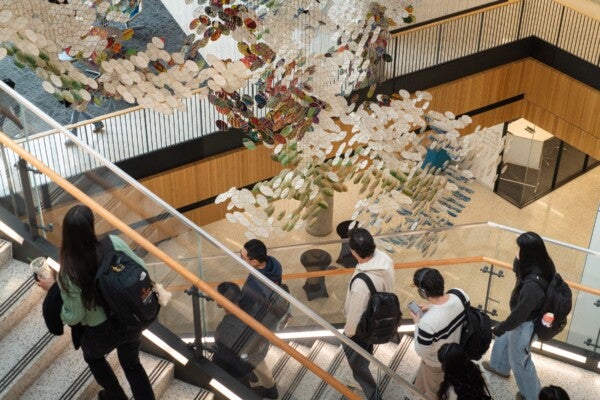
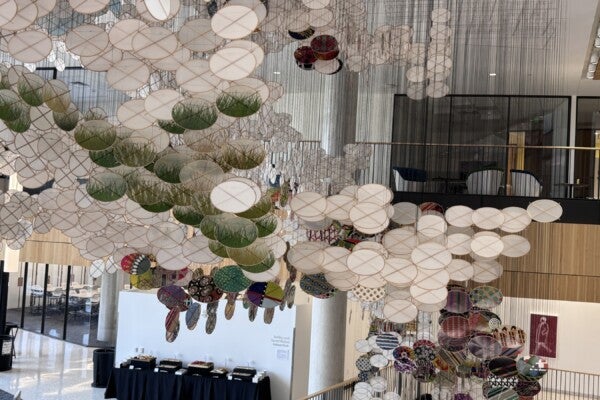
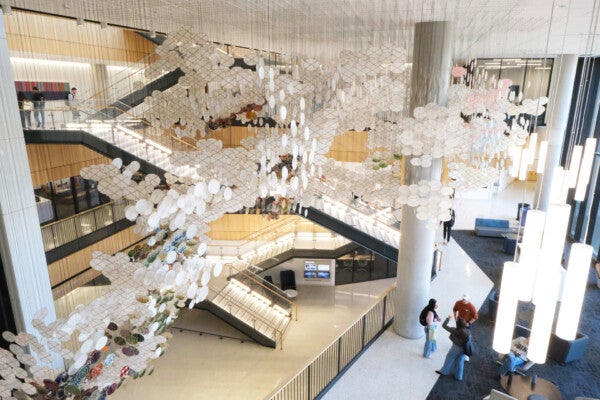
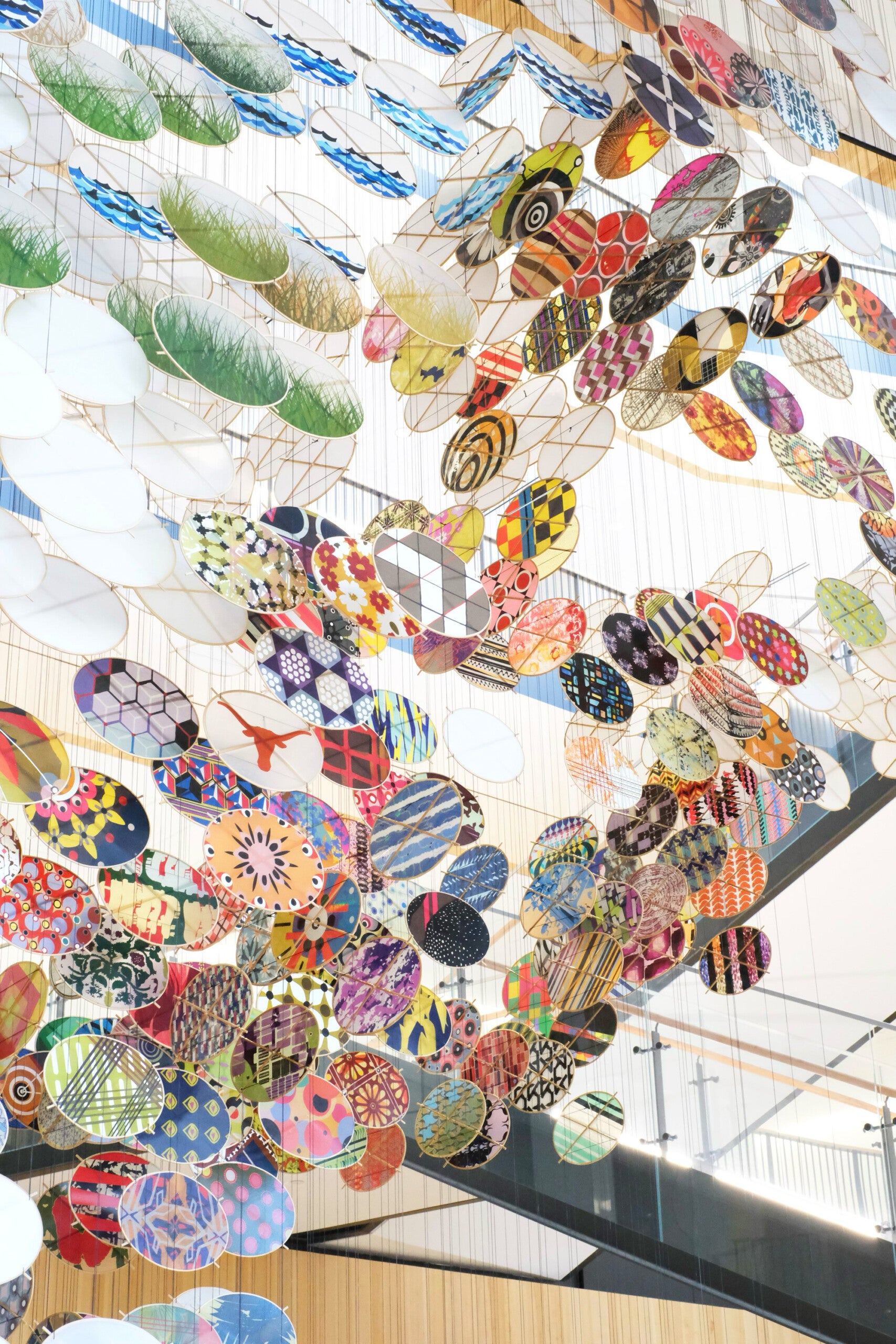
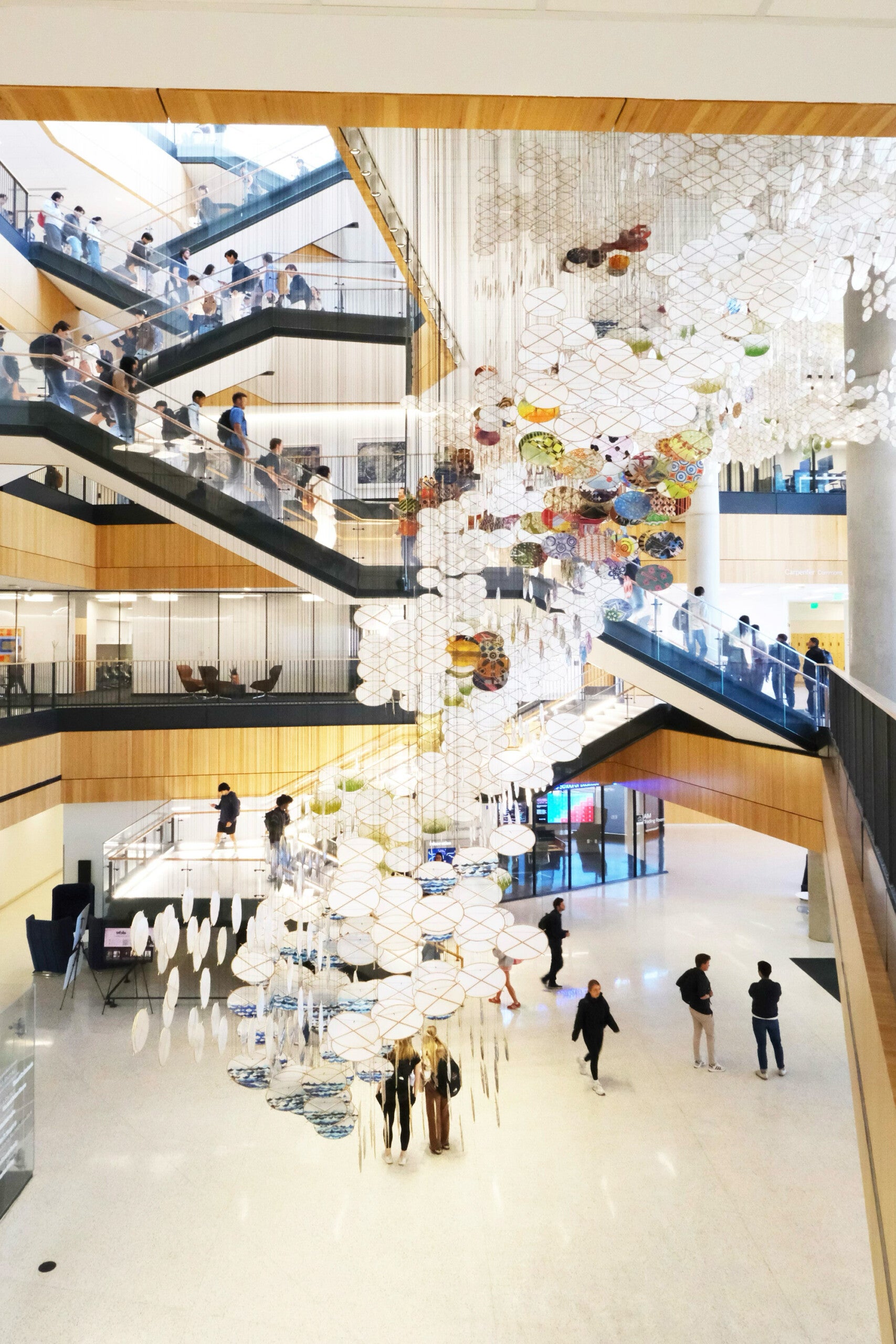
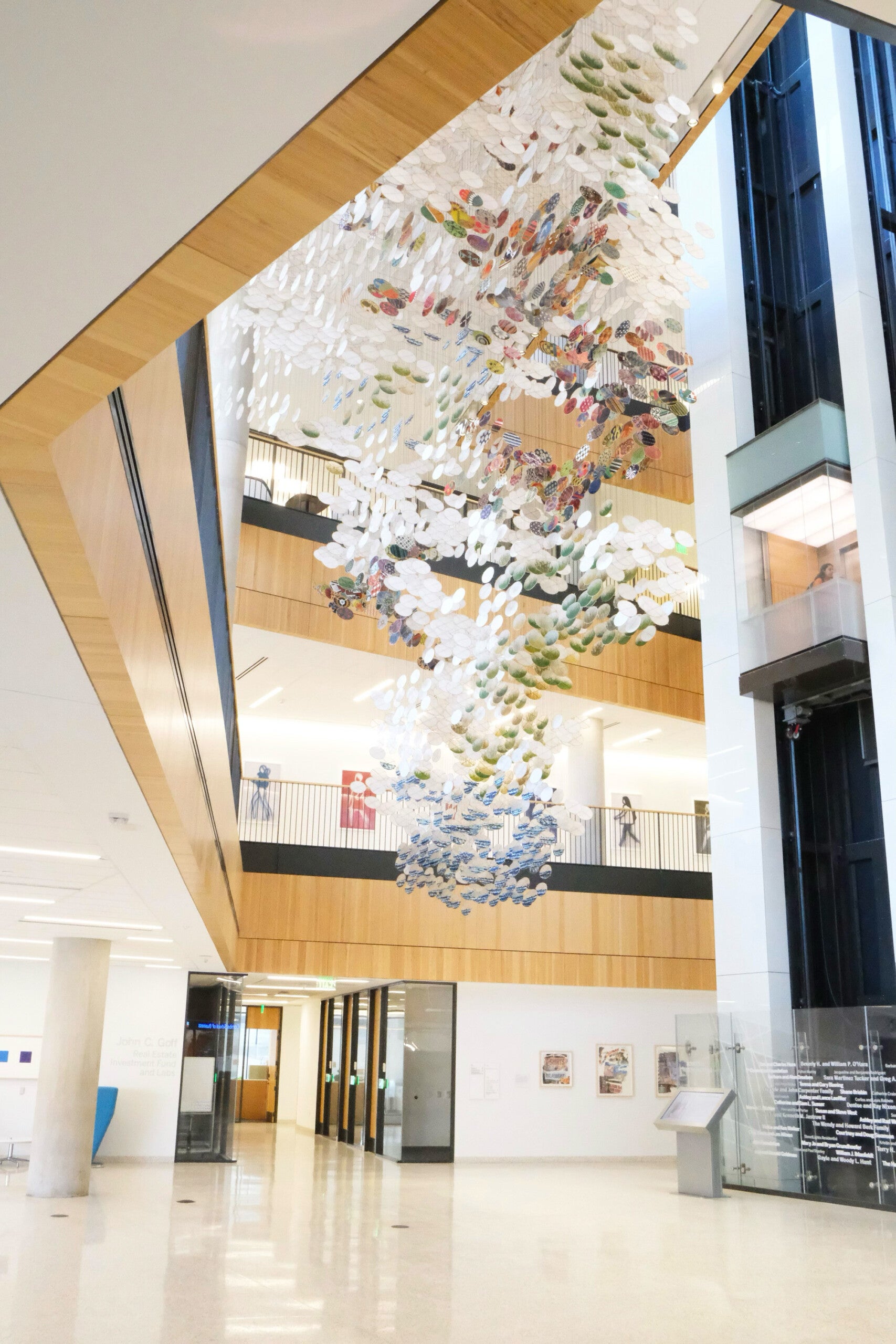
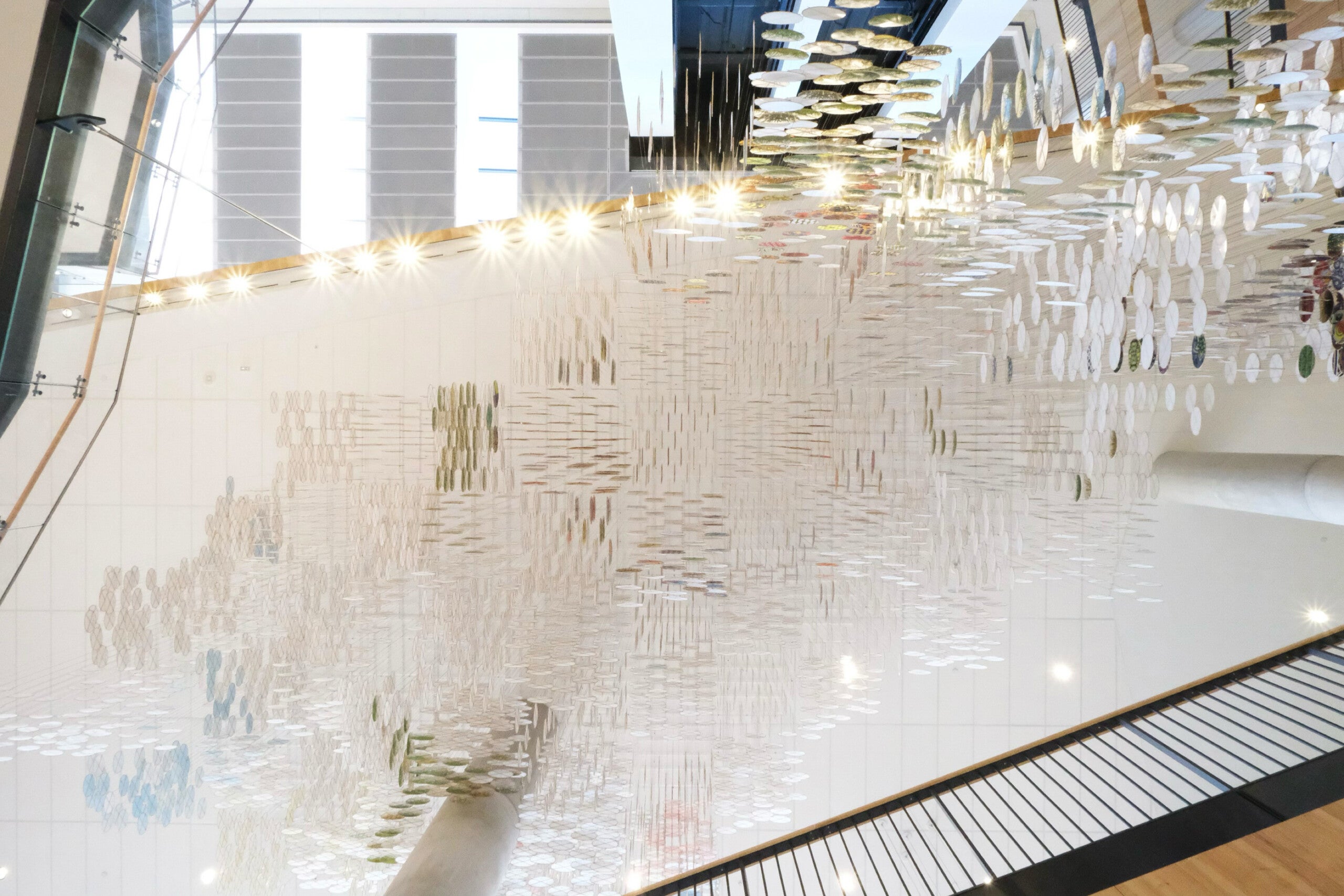
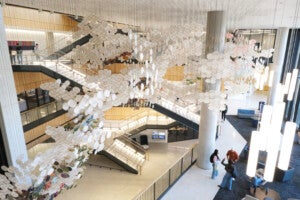
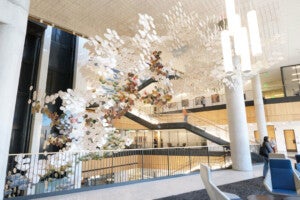
The Jacob Hashimoto installation, “The Wind’s Gathering Applause,” 2025, has been transformative for Robert B. Rowling Hall, the academic home for graduate students of the McCombs School of Business at The University of Texas at Austin. Commissioned specifically for the space, it hangs 47 feet from the ceiling through the five-story atrium, its 5,000 delicate bamboo-and-paper kites suspended in motion.
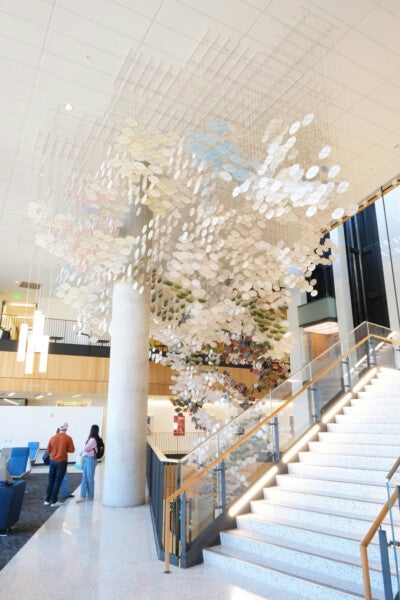
“The work never looks the same twice,” says Tina Mabley, senior assistant dean for the Full-Time MBA program, who offices in Rowling Hall. “As the light shifts, your vantage point changes, and new details emerge and spark curiosity.
“We especially love that Hashimoto drew inspiration from Austin’s landscapes and cultural symbols, making the piece uniquely tied to McCombs and this place,” she says.
The piece is part of a permanent installation completed this spring of 71 works by 23 artists, generously underwritten by Carolyn and Preston, UT ’62, Butcher.
Based in Ossining, New York, Hashimoto is known for creating layered, complex worlds from modular components including bamboo-and-paper kites, model boats, even AstroTurf-covered blocks. He is a graduate of the School of the Art Institute of Chicago, and his work may be found in the collections of The Metropolitan Museum of Art, New York; Fondation Carmignac, Porquerolles, France; Los Angeles County Museum of Art; Tokiwabashi Tower Art Collection, Tokyo, Japan; and many other private and public spaces.
The son of a Whitman College English professor, Hashimoto pushes to bring public art to university spaces. At Rowling, he relishes the surprise of artwork in a business setting.
“When you move into that building, you don’t know that the artwork is there. So, when you discover it, there’s a sense that there is much more to be learned here,” he says. “It’s like a magical thing that opens this door of possibility. Well, what else does this building have? What else can be discovered?”
The cloud-like form is designed to be viewed from all sides and levels of the Rowling Hall atrium, and it draws on a lexicon of more than 500 graphics developed by the artist to reflect touchpoints suggested by the McCombs art advisory committee.
“It is personal to us, and I am struck by the movement from water and prairies, up through the city, to the skies,” says McCombs Dean Lillian Mills.


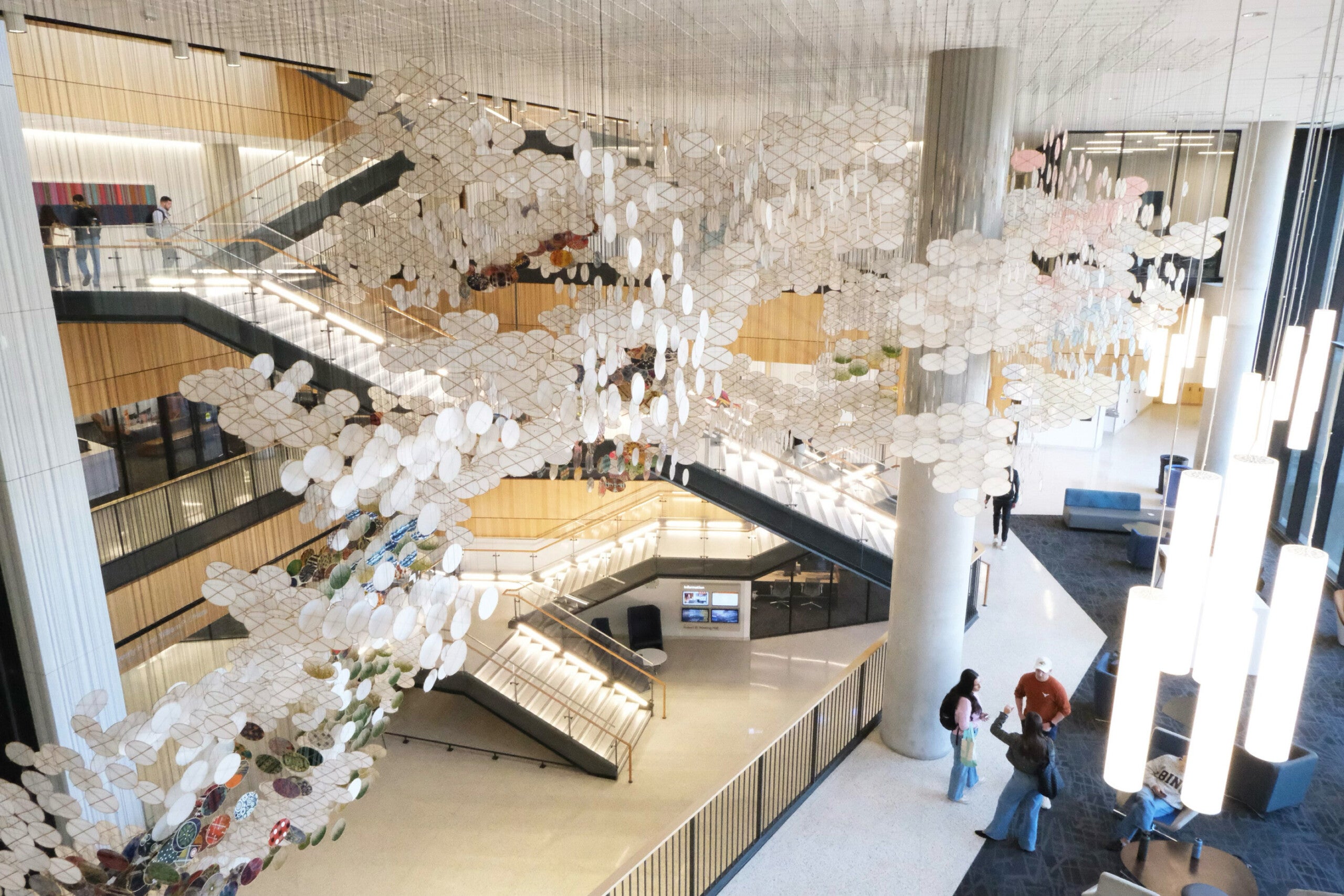
Volunteer art ambassador Jerin Monkottayil, MBA Class of 2027, says he was astounded by its size when he first saw the installation.
“It really filled up the building with color and a certain warmth,” he says. “Standing on the stairs and trying to unpack the different circles was a common theme of my first week back to campus.”
Hashimoto appreciates this thoughtful reaction and hopes other visitors will also stop. “As an artist, you’re trying to create places where people feel the impulse to engage their minds and their bodies in the experience,” he says.
“For me, the successful work lives if you can make people pause long enough to just give a little bit of thought, right? And ask themselves about meaning, about why this is here, what it’s doing, what your relationship is with it.”
Because he believes so strongly in the viewers’ personal experiences, he resists the temptation to explain the piece’s title. Like the work itself, the title is a curiosity — another entry point for engagement, he says.
Behind the Concept of Suspended Art
The idea of commissioning Hashimoto’s work for the atrium was a striking contribution from Mindy Taylor Ross, owner and chief curator at Art Strategies LLC, a fine art consulting agency engaged to help with the selection and installation of art for Rowling Hall.
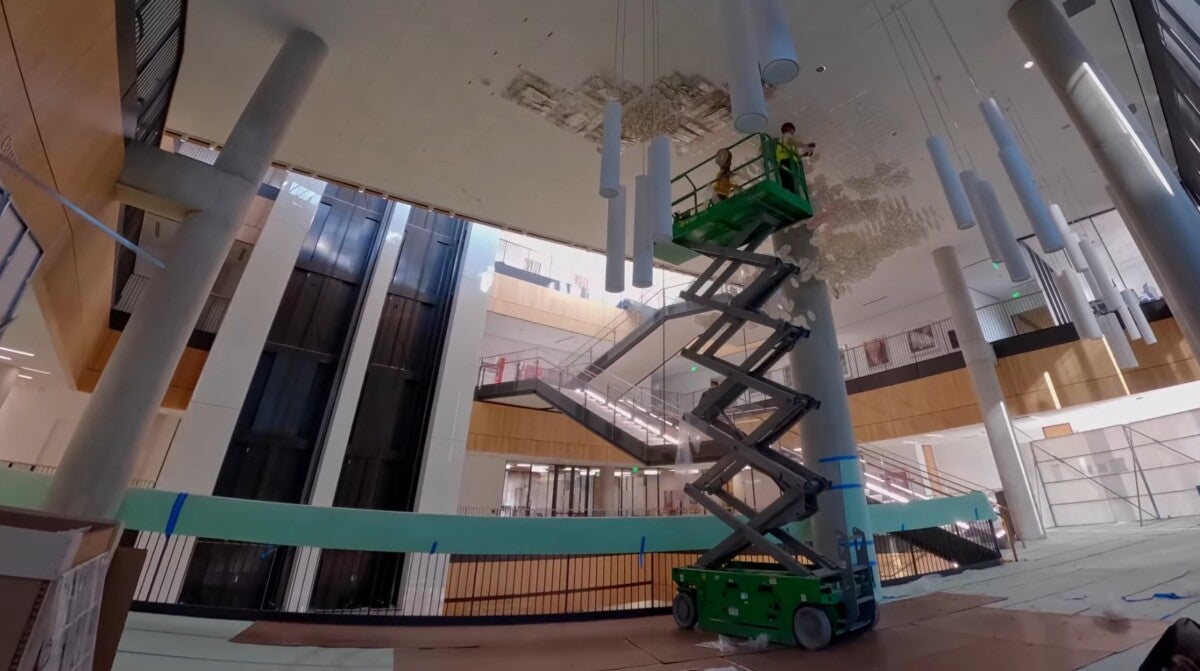
During their first visit, she and her colleague were struck by the majestic volume of the unadorned space and the limitations of working around frequent crowds and events.
“It’s almost like a beehive. So busy,” she says. “There was lack of a central focus, but something like a sculpture on the floor wouldn’t work.
“Could something be suspended? Could we bring in some color from the outside? How could it complement the architecture?”
Ross’ research led to engaging Hashimoto and his team for “a very cool collaborative process” that folded local arts, culture, and landscape into his signature style. Images of a Moonlight Tower, the Colorado River, a longhorn, and cowboy boots helped feed his creative process.
Hashimoto, who worked with a crew of about six on the project, explains that the inspiration moved beyond literal images.
“We don’t want a bunch of pictures of cowboy boots. We want something that feels like that stitched loop from the boot. People in Austin know what that is,” he says.
“Later in the day, when you’re looking at somebody’s boots, you’re like, oh, that’s where they got that.”
Many of the final graphics are abstract, but viewers are encouraged to find two “Easter eggs” hidden in the mix: one with a Bevo pattern and a single Bevo.
Story by Sandra Kleinsasser
Explore the Collection
Connecting Through Art
Student and staff art ambassadors build appreciation, dialogue around new installation in Rowling Hall
Artistic Inspiration in Rowling Hall
Gift of contemporary art creates moments of discovery throughout McCombs’ graduate programs building
Discovery Guide
Learn about the artists behind the 71 works of contemporary art housed in Robert B. Rowling Hall
Floating on Air
Stunning Hashimoto art re-defines Rowling Hall gathering spaces
About this Post
Share: