Forecasting Sources of Energy to 2050
Fossil fuels will meet a significant portion of global energy needs through mid-century, say public and private forecasts
As the new year begins, renewed attention is turning to the long‑term trajectory of global energy markets and the realistic balance of sources that will power economies through 2050. Policymakers, investors, and researchers are entering 2026 with a sharper focus on how the energy transition is unfolding in practice — not just in aspiration — and what the latest forecasts suggest about the enduring role of both emerging renewables and traditional fuels in meeting future demand.
In 2022, Congress enacted the so-called Inflation Reduction Act, whose objective was to “accelerate the transition to clean energy and reduce greenhouse gas emissions.” An inadvertent result of that act was to give rise to the thought that traditional sources of energy would no longer be needed.
Among the more extreme forecasts, the research and consulting firm Enerdata somewhat exuberantly wrote, “71.1% of North American final energy consumption” would come from renewable sources by 2050. It has led some of my academic colleagues to change their previous research and teaching focus away from traditional sources of energy.
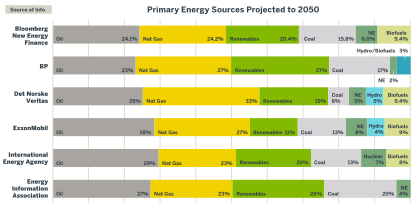
But a wide variety of forecasts, both public and private, tell a different story. These forecasts detail the mix of primary sources of energy at the midpoint of the 21st century. Thus, they constitute a valuable basis to inform public policy and private sector investments.
I believe the important conclusion to infer from the forecasts reported in the graph is this: Although solar and wind renewables may rise to provide 25% of 2050 global energy needs, historical sources of energy, oil and natural gas based on fossil fuels, will continue to provide 50% of the energy we consume.
It is of paramount importance to note the sources of forecasts come from a wide range of independent actors: Two are reputable U.S. and international public agencies (the U.S. Energy Information Administration and the International Energy Agency), two are private oil companies (Exxon Mobil and BP), one is a consulting firm (DNV), and the last is a data provider (BloombergNEF). The range of forecasters across these three different categories, along with the broad agreement of their predictions, provides additional confidence in the forecasts’ robustness.
National energy policy has been changing since last January, the emphasis moving from the prior administration’s focus on clean energy to increasing the production and availability of fossil fuels with the aim of lowering energy costs and boosting innovation. It’s possible that the shares of energy consumption from these historical sources will be even higher than forecast.
The policy implications from the forecasts of primary energy sources are straightforward. First, since fossil fuels will continue to play a central role in global energy consumption for the foreseeable future, it is prudent to ensure the stability and reliability of oil and natural gas production to meet ongoing demand.
Second, a free-market perspective would indicate the federal government should let the market determine the optimal amount of investment in clean and traditional sources of energy.
Since energy security is important, policymakers might focus on ensuring reliable access to energy supplies from diverse sources in this hemisphere and beyond. This could include restoring strategic reserves and exploring international energy partnerships.
Ehud I. Ronn is a professor of finance in the McCombs School of Business at The University of Texas at Austin. His research and teaching interests focus on the valuation of energy commodity-contingent securities. Ronn has published articles on investments, interest rate instruments, and energy derivatives in the academic and practitioner literature.
About this Post
Share: