AI Prompts Recalibration in Business of Healthcare
At UT healthcare symposium, McCombs Dean Bradley R. Staats explains how ‘AI amplifiers’ will lead amid industry disruption
opportunity to shape the future of healthcare – and the health of millions of people – by
helping determine how to incorporate artificial intelligence.
With a dean steeped in industry best practices, a nearby academic medical center on the way, and AI-forward research and curricula, McCombs School of Business is poised to lead in the business of modern healthcare.
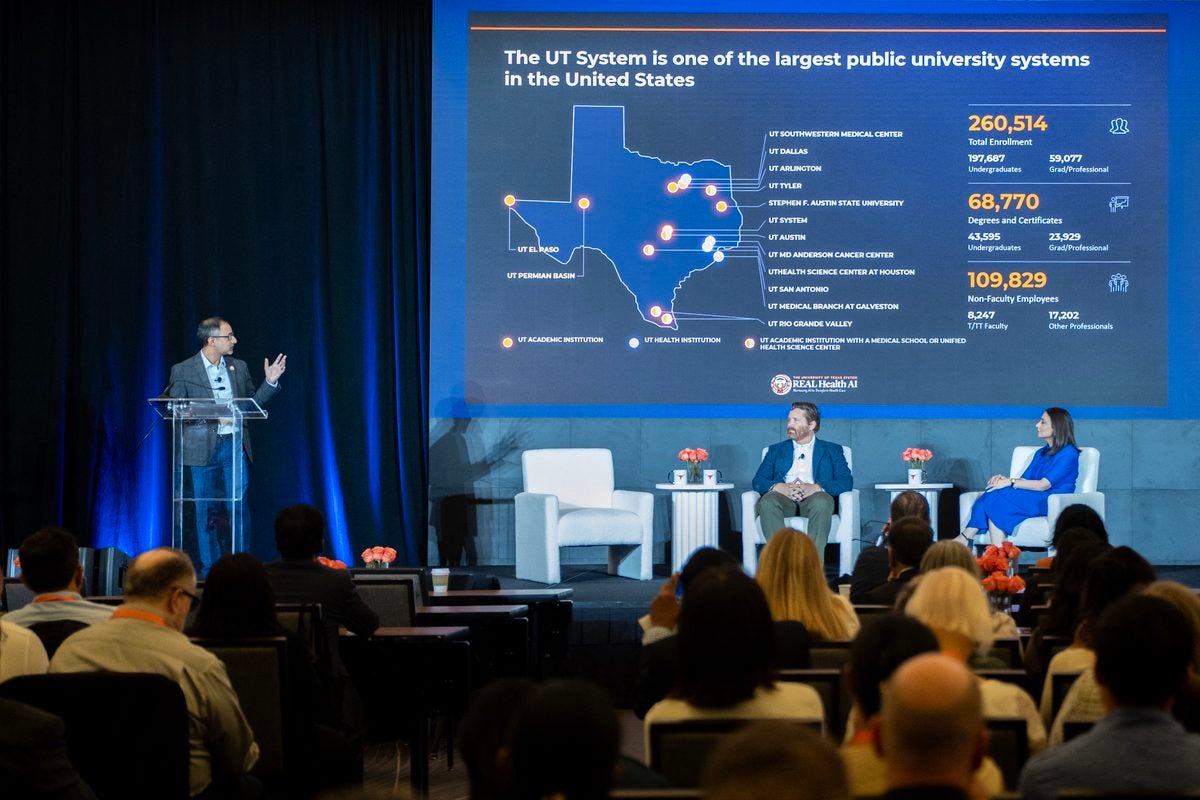
With that in mind, McCombs Dean Bradley R. Staats was one of several speakers at the University of Texas System’s recent REAL Health AI Symposium. The event convened entrepreneurs, physicians, business leaders, researchers, and other industry insiders to discuss the challenges AI poses to their field, its possible benefits, and how they can be the ones to shape healthcare’s technological frontier.
Teaching timeless skills
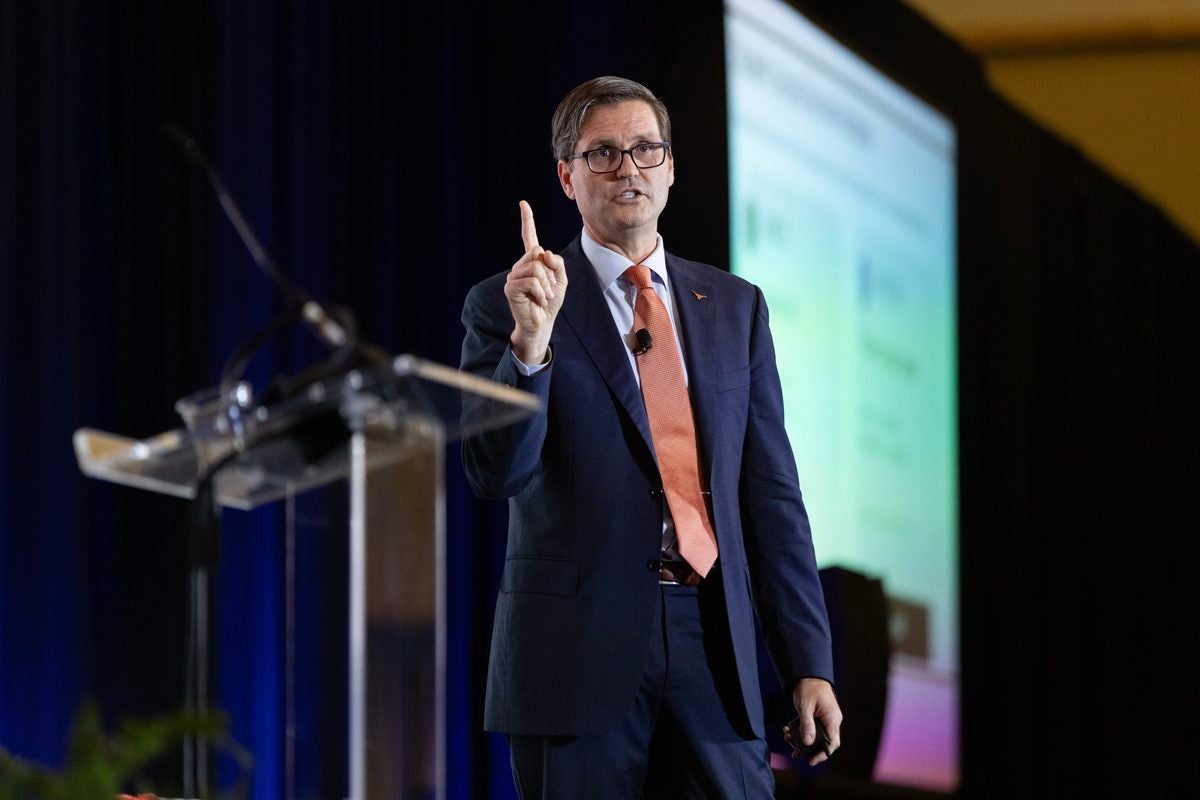
In his session, “Business Education for an AI-Driven World,” Staats promoted the idea that successful healthcare leaders must now be “AI amplifiers” –– they should know how to effectively use AI to enhance their work, rather than simply relying on it to do their work for them. He expects that desirable jobs won’t be replaced by AI itself, but that they will be replaced by workers who know how to use AI most effectively.
Learning to use AI tools effectively is already a core component of the curricula at Texas McCombs. The school’s specialized master’s programs include an M.S. in Business Analytics and AI, and an M.S. in business technology and AI, and every undergraduate and graduate program weaves in hands-on AI tools and projects tied to real business problems.
Graduating students who are experts in using AI is crucial, Staats says, because companies are now looking for “AI natives” when they hire. And for students who may feel intimidated by that expectation, Staats cited results from a recent McCombs and KPMG study that found workers who used AI as a “teammate” to perform a task performed better than if they or the AI performed the task independently.
Staats is as optimistic as ever about students’ job prospects after graduation. One reason is because data doesn’t definitively indicate that AI has had the negative effect on hiring that some have claimed.
“In trying to predict, where is this future headed, in terms of some of the macro concepts, anyone who does it overly confidently, we should be skeptical of,” Staats said.
who work collaboratively with AI tools will be most competitive in a changing healthcare
industry.
A need for structural change
The symposium also included sessions covering AI-powered wearables, computer-chip manufacturing, and the AI-driven hospital experience. But just as prominent were sessions that drilled down on the complexities of the current healthcare system and how its structure must change before AI can ever make it more efficient or profitable.
In their session, “Paying for Intelligence: The Economics of Health AI,” Stephanie Carlton from the Centers for Medicare and Medicaid Services and Stanford physician and health economist Kevin Schulman described intractable problems the industry has been grappling with for decades —insurance reimbursement, ballooning operational costs and more—and how simply tacking AI onto the existing system would not be a silver bullet.
“We’re spending not one dime trying to think about, ‘How do we redesign the healthcare system?’” Schulman said.
For example, he says the way payments are processed is “fatally flawed.”
“We have this hybrid system of public and private, but no one’s in charge,” he said. “No one’s in charge of making sure that transactions are processed efficiently and smoothly.”
He argued this fundamental problem must be fixed before the industry makes significant investments in AI.
In a related session, “The AI Skills Gap: Health Care’s Next Crisis?” tech investor and president of TowerBrook Advisors, Eric Larsen, argued that any retooling effort must account for AI’s effect on the workforce. Some jobs may become automated, others may involve AI-assistance, while others may become obsolete; this is the “elephant in the room” he says no one wants to talk about. That matters because healthcare workers make up 16% of the American workforce and support a system worth trillions of dollars. Larsen expects, in the short term at least, that AI will mostly replace work that is currently outsourced abroad.
“There’s a lot of cartoonish overstatement of job dislocation,” Larsen said. “My own heuristic is that if you can decontextualize a workflow and put it in another country, you can repatriate it to these shores and give it to the algorithm.”
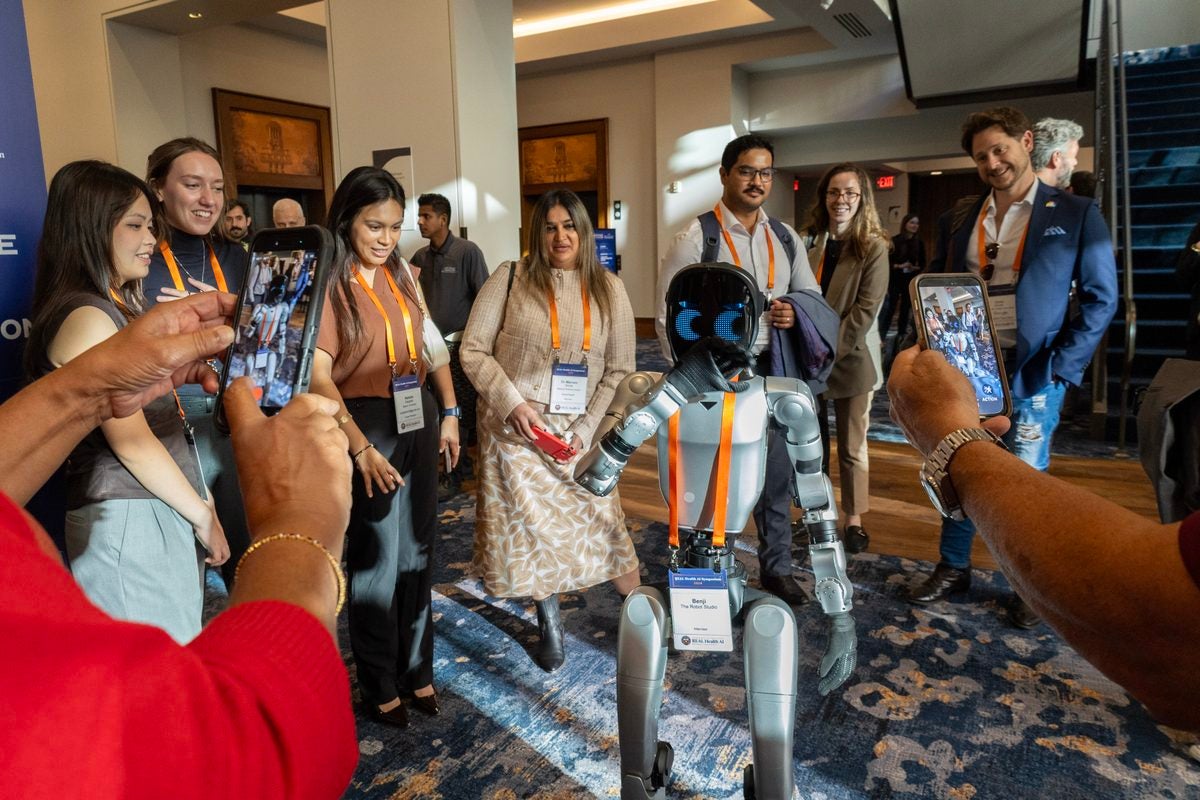
crowd-pleaser and a fitting symbol for the deep discussions panelists were having about
the role of artificial intelligence in healthcare.
CFOs leading the way
Also on the industry side, some healthcare chief financial officers described how they’re now leading decision-making about AI in their organizations —a leadership role they say is new. In their session, “The Economics of AI,” finance leaders from some of Texas’ largest healthcare providers say their expertise with financial data gives them greater insight than some of their colleagues about AI’s potential risks and benefits to the bottom line.
The new responsibility has been daunting, they say, but the possibility that AI could change business models is exciting. MD Anderson Senior Vice President and Chief Financial Officer Omer Sultan says, for example, AI could better monitor a provider’s quality of care, which could pave the way for value-based healthcare —a model some experts argue improves the quality of care and reduces costs.
“Conceptually at least, artificial intelligence opens up the opportunity for us to measure the quality at a level that we would have never thought of in the past,” he said. “We could change around the incentives and actually start to reward systems that are delivering care that is more consistent with…what we want out of our health services.”
But right now, they’re mostly focused on how AI can improve a company’s operational nuts and bolts. For example, AI can aggregate much more data than any human, as well as other costly and “mundane tasks,” says Translucent CEO and Founder Jack O’Hara. Some of those mundane tasks also include the administrative processes that often burden physicians, says Stephanie Swanson, CFO of The University of Texas Southwestern Medical Center.
“What can we do to give that scarce resource [physicians] back their time and [do] things that are a lot more value-add?” she said, also arguing their work should be “less about going through 14 different navigation screens” when they’re working with patients.
Still, it’s an experimental time. CFO of The University of Texas Medical Branch at Galveston Jamie Bailey says he is actively testing the uses of AI that make the most financial sense. The work is unprecedented, so it’s up to him to determine what success looks like.
“What we’re trying to develop across all the spectrums is, how do we identify those key performance indicators, whether it’s time savings, efficiency savings vs. what I would say is hard-dollar savings?” he said.
Getting ahead of it
The overarching sentiment throughout the symposium was that AI will undoubtedly change the healthcare industry, but that the industry itself can determine what change looks like.
The trick, leaders agreed, will be implementing AI as it advances at breakneck speed. Larsen from TowerBrook Advisors says it could take a decade to “assimilate” AI in its current form into the healthcare system. But in 10 years, that technology will likely be obsolete. The most recent AI models have already moved, unfathomably, beyond intelligible language, he says.
“The models are retreating into a high-dimensional space that we simply cannot understand,” Larsen said.
Perhaps the only way for the industry to truly adapt will be to fall back on timeless human skills. Staats preaches an ethos of lifelong learning to keep workers adaptable, nimble, and capable of building expertise in challenging concepts like AI, even in moments of great uncertainty.
“In a world that’s changing around us, we have to be learning constantly, then we have to put ourselves out there, be willing to have something go wrong, pick ourselves back up from it, and off to the races,” he said.
Story by Caroline Covington
About this Post
Share: