When to Move Is Key to Mobile Retail
Vendors can maximize sales by optimizing transit times
Based on the research of Junyu Cao and Zhuolun Dong
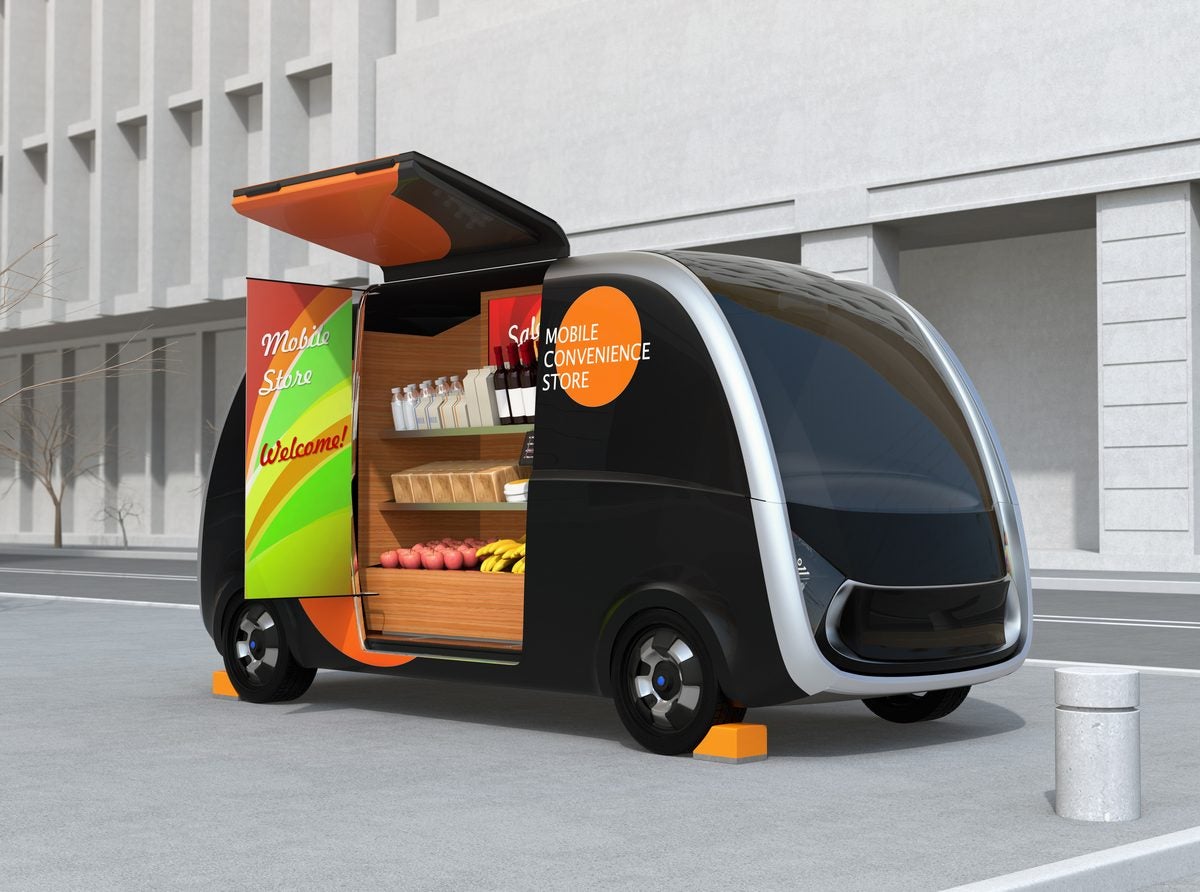
In recent years, the principle behind the humble ice cream truck has been getting a high-tech makeover. Retailers are reinventing mobile stores — both people-piloted and self-driving — often selling perishable items such as baked goods or fresh meals. BPM Analytics projects sales from retail on wheels will grow to $30 billion worldwide by 2030.
Mobile retail is a middle ground between in-store shopping — where customers can see and touch products — and online retail, where someone else picks and delivers their orders.
Going where customers are can boost revenue, says Junyu Cao, assistant professor of information, risk, and operations management at the McCombs School of Business at The University of Texas at Austin.
“The profits of a mobile store can surpass stationary or brick-and-mortar locations because it has the ability to move and find fresh crowds,” she says.
But when should a store make a move? The longer it stays in one spot, the more customers it serves. But demand drops quickly, because most people buy almost immediately. Meanwhile, if the products are perishable, they lose freshness over time.
In new research, Cao offers a strategic approach for retailers to juggle these considerations and decide how to deploy their fleets.
Stay Put or Move On?
With Zhuolun Dong, a McCombs doctoral student, and Wei Qi of Tsinghua University, Cao built a mathematical model that determines the optimal balance between perching — staying in one place to sell — and migrating — driving to a new location.
The researchers modeled a system of nine vehicles operating 12.5 hours a day. Drawing on real-world data from Neolix, a Beijing-based company whose autonomous vehicles deliver meals to office park and industrial workers, they integrated three variables:
- How quickly demand at a given spot dries up after the store arrives.
- How fast a product loses freshness over time.
- How much ground a store can realistically cover in a day.
They found four factors for maximizing revenue from stores on wheels:
Time of day. Early in the day, stores should move frequently. They should hit as many locations as possible to capture customers when goods are freshest.
As the day goes on and products get staler, stores should stay longer at each stop so they can squeeze out remaining demand before relocating.
Customer density. Busy stores do better to focus on heavily populated areas rather than trying to cover the whole map.
Demand intensity. If a store has steady, trickling demand rather than rushes such as lunchtime, it should stay longer in one spot rather than take time to drive between locations.
Fleet size. When stores are busiest, adding more vehicles pays off proportionately. Each new mobile store can claim its own high-demand territory without overlapping with others.
But when stores have slower sales and more time to roam, returns shrink. Each new vehicle ends up competing for the same customers as the others.
New Map for Wheeled Retail
Mobile retail operators can use Cao’s model to create optimal routes, she says. Traditional food trucks, which tend to anchor themselves to one location, could increase their revenues by adopting a more dynamic strategy.
She sees such stores as an increasingly attractive option, especially for small businesses who might struggle to raise capital for stationary stores that have high up-front and operational costs.
“A mobile store is low cost,” Cao says. “You can utilize this mobility to run a better business. I think many businesses can be mobile.”
“Retail on Wheels: A Time-Sensitive Traveling Salesman Problem” is forthcoming in Management Science.
Story by Deborah Lynn Blumberg
About this Post
Share: