Shaping Early-Career Success in the Age of AI
A UT Austin and KPMG study finds that uniquely human skills create value only when they are applied to direct and improve AI
Based on the research of Ashish Agarwal, Anitesh Barua, Anu Puvvada, Fangchen Song and Wen Wen
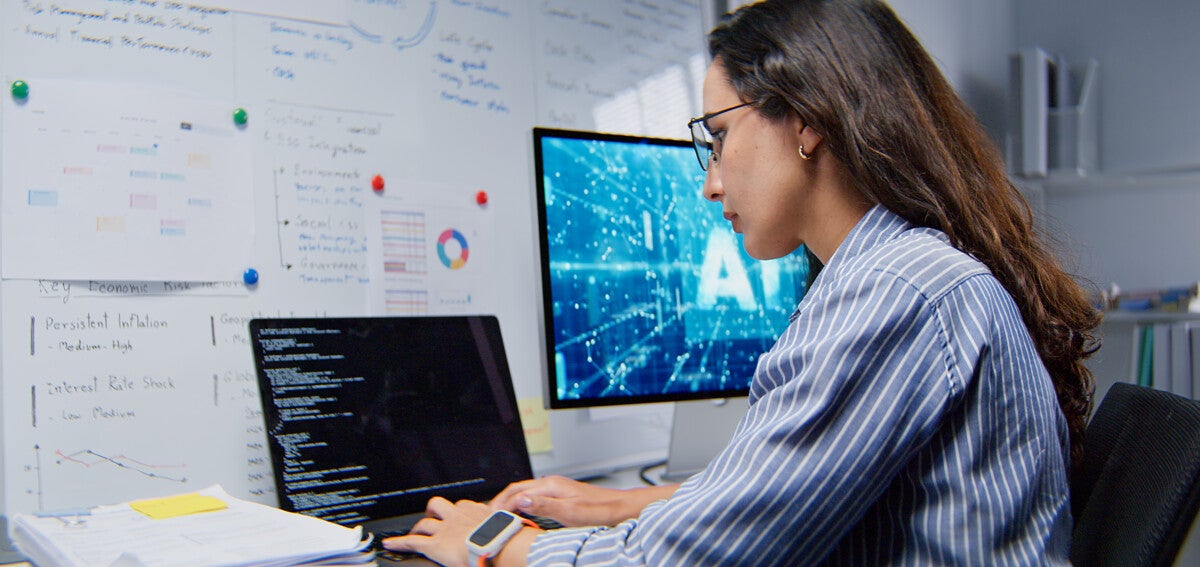
A field study of 523 early-career professionals working with artificial intelligence agents reveals that employees with nearly identical knowledge and skill can produce dramatically different results once AI enters the workflow, offering organizations greater insight into developing early-career talent in the AI era.
The joint study by KPMG LLP, the U.S. audit, tax, and advisory firm, and the McCombs School of Business at The University of Texas at Austin, published today in Harvard Business Review, finds that as AI grows more capable, performance depends just as much on how they direct AI and evaluate its work as what they know. The encouraging news for organizations: Many employees who don’t yet outperform AI already have what it takes to become high performers with the right support.
What Distinguishes Employees Who Create Value Beyond What AI Can Do Alone?
In the study, early-career professionals completed work using an AI agent that closely mirrored client work they would perform in their area of focus. The research team first established an AI-only baseline by asking agents to complete the work without any human involvement. Then, they measured how these early-career professionals performed when collaborating with the same AI. The analysis surfaced three distinct performance profiles:
- AI Amplifiers (50.1%) outperformed the AI baseline.
- AI Delegators (25.8%) produced results comparable to AI alone.
- AI Apprentices (24.1%) performed below the AI baseline.
The surprise: Traditional measures of capability didn’t explain the gap. Those who outperformed AI looked nearly identical on paper to those who didn’t.
“We weren’t simply looking for people who knew how to use AI,” said Ashish Agarwal, McCombs professor of information, risk, and operations management (IROM) and co-author of the study. “We wanted to understand what enables some individuals to consistently create value beyond what AI can produce on its own.” Agarwal and McCombs coauthors Anitesh Barua, professor of IROM; Wen Wen, associate professor of IROM; Fangchen Song, Ph.D. student; and KPMG Studio Leader Anu Puvvada highlight the following distinctions:
AI Apprentices matched Amplifiers and scored higher than Delegators on every foundational skill, yet they landed below the AI baseline. Apprentices also critiqued AI’s output, but the critiques rarely improved it, often chasing irrelevant issues or steering the AI the wrong way. That makes them the biggest pool of untapped potential: If they can pair their traditional capability with more sophisticated AI use, they will outperform AI. This cohort underscores what researchers learned in their first collaboration with KPMG: Organizations need to invest in continuous learning and development to help employees become more effective and sophisticated users of AI.
AI Delegators scored lowest on foundational skills but weren’t the weakest performers, because AI already produces competent output. They accepted it with little scrutiny and added little of their own. Many typical low performers probably land in this category, which requires organizations to implement new approaches to performance assessment that evaluate critical thinking and judgment in how work is done, not just the outputs delivered.
AI Amplifiers turned capability into performance, orchestrating the workflow, framing problems to guide the AI, anchoring the work in real domain frameworks, and refining results across multiple rounds. They treated AI as a collaborator that needed direction, oversight, and judgment. This underscores that performance can be scaled by elevating these individuals into coaches who continuously raise how teams work with AI.
KPMG is bringing these insights into the work the firm is doing to help clients redesign workforce development, learning programs, and role design for an AI-enabled future.
The research highlights that, as AI handles more of the baseline of early-career knowledge work, the organizations that adapt best won’t just build AI-literate employees. They’ll build new operating models where value comes down to how well people apply judgment inside well-designed AI workflows.
Applying The Insights to Develop Talent
The study focused on early-career professionals, but the implications run across the whole workforce, and they’re reshaping how KPMG is approaching employee development.
This summer, KPMG launched You Can with AI: Next Level Learning, a firmwide initiative to grow AI Amplifier behaviors for all levels, including partners. Employees start with a skills check that assesses how they interact with AI and approach problem solving, then follow personalized pathways that blend coursework, simulations, on-the-job practice, and a growing AI champions network. Much of the learning happens in the flow of work, with simulation exercises that mirror real client scenarios. The same approach is reshaping National Intern Training at KPMG Lakehouse, starting with the company’s audit interns this summer and expanding across its tax and advisory teams.
“This is the most AI-native generation entering the workforce, so if fluency with the tools isn’t what sets the top performers apart, that tells us something about our entire workforce,” said Rahsaan Shears, AI enterprise transformation leader at KPMG US. “How people applied their knowledge and skill is what made the difference, and that gap is coachable. The opportunity for organizations is to build the training and workflows that enable far more people to turn their knowledge and skill into impact, at every level.”
This is the second study in collaboration with The University of Texas at Austin’s McCombs School of Business to identify the skills, behaviors, and capabilities that enable people to create value in the age of AI.
Story by Judie Kinonen
About this Post
Share: