Coming Home: Q&A With Dean Bradley R. Staats
McCombs’ new dean on listening first, learning always, and why he’s happy to be home
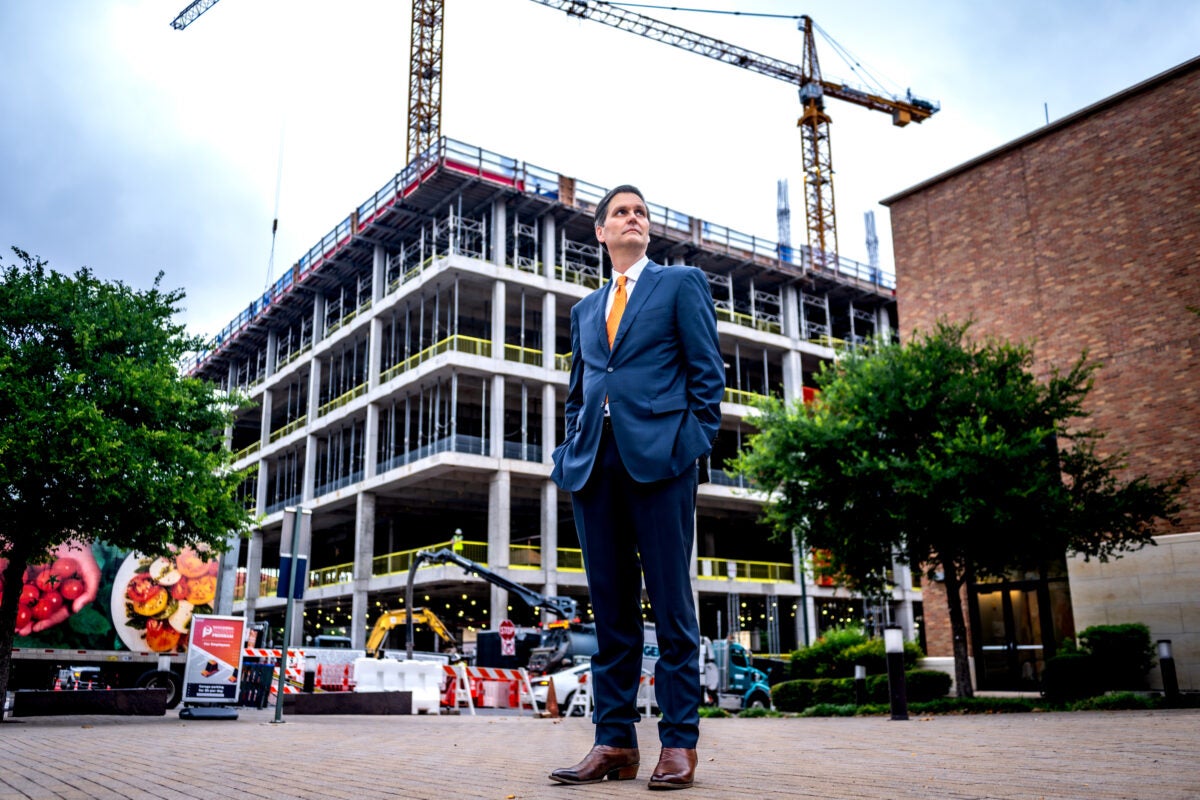
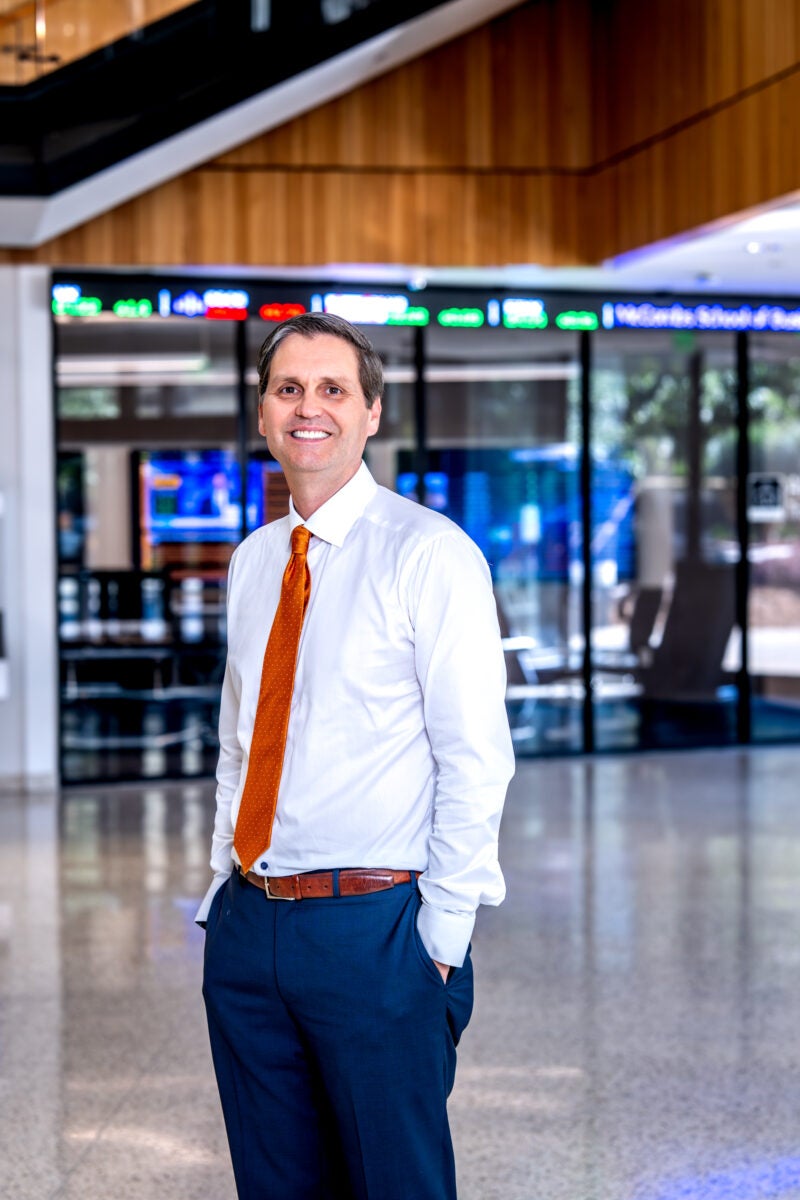
When Bradley R. Staats joined the McCombs School of Business on July 1 as dean, he was returning to familiar ground. A third-generation Longhorn and Austin native, Staats knows something of the University’s DNA. And after 17 years at the University of North Carolina Kenan-Flagler Business School, he also knows business academia. His stated goal now is plain: to learn McCombs.
In this conversation, he articulates his “listen first” leadership style, his “I-shaped” paradigm for education, and his optimistic take on artificial intelligence. He also shares some of his hopes for life back in Texas, including brushing off his two-step and making good use of his closet full of burnt orange, which, he says, goes with everything.
Q: You’ve described your first months as dean as both a homecoming and a learning tour. What has that looked like so far?
When I told the chair of the board at Kenan-Flagler that I had accepted this position, he said, “I guess I’m not surprised you’re going back to Texas: You never took your cowboy boots off.”
So, I’ve been an orange blood my whole life. Two years ago, my wife, Tricia, and I were here for the Florida game, walking down Bevo Boulevard, talking about how great it would be if we could come back.
Then, when this opportunity came along, it crystallized something I had been thinking about: McCombs has the foundation to be “the” public flagship business school.
For me, leading that charge now starts with quickly learning the school. That means a lot of one-on-ones, a lot of questions, and a lot of trying to meet people wherever I can. It’s about understanding what’s phenomenal and needs to be preserved, where people see opportunities to build something new, and where there may be places to pivot.
A few things we’ll keep moving on right away. The intersection of AI and business education is one of those. But broadly, my goal is to spend this first phase learning as much as possible as quickly as possible, building trust, and then using that to inform a strategic planning process that engages the school.
Q: What have your first impressions of McCombs been?
McCombs is a jewel on this campus. I’ve yet to talk to a stakeholder who doesn’t see it that way.
That’s exciting, because it means the conversation is, “What comes next?” There’s already so much here that any dean would want: exceptional faculty, outstanding students, deeply committed staff, and a powerful university ecosystem. Under the leadership of President Davis and Provost Inboden, the University has a bold vision for the future, and McCombs is uniquely positioned to help bring that vision to life. We have unparalleled potential to engage with world-class engineering, computing, healthcare through Dell Medical School, while drawing on the remarkable innovation ecosystem of Austin and the broader Texas economy. It’s all here.
I love to build. I’m a business academic because I fundamentally believe in what business can unlock for people and the economic opportunity it creates. We have the privilege of preparing current and future capitalists to create value and make a meaningful impact on the world. McCombs is already in a position of strength, and that creates an incredible opportunity to build what’s next.
Q: The business school landscape is changing fast. What do you see as fundamental for McCombs students?
Thinking about what a great education looks like, it ties to my own experience at UT. As a way to think about it, I use a capital letter “I” with serifs.
The top horizontal line on the “I” is breadth, opening you up to different ways of thinking. In business, yes, that means exposure to finance, marketing, operations, and accounting. But it also means learning how to see the world from multiple angles. At UT, I was a triple major in electrical engineering, Plan II Honors, and Spanish, so I got that breadth in philosophy classes, reading classical works that I never would have chosen to read on my own, and having conversations that pushed me out of my comfort zone.
Then the middle of the “I” is depth. You need expertise to know how to wrestle a problem to the ground. My engineering training gave me that, and that kind of rigor in any discipline matters tremendously.
And then there’s the base of the “I,” which is activation skills. I was an active student, served in the Student Engineering Council, led Texas Revue, was president of my fraternity, and was a Silver Spur. UT offers students tremendous opportunities to engage and discover: How do you learn best? How do you get yourself to do what you need to do? How do you get others to do what you need them to do?
And the other thing I would say about how my undergraduate time shaped me, and I only appreciated more with time, is community and relationships. You build ties that last a lifetime.
As dean, I am thinking about how we build infrastructure to ensure the depth, breadth, application of knowledge, and community for students across McCombs.
Q: As someone who’s spent much of your academic career studying organizations and performance, what are your thoughts on leadership?
I tend to think in alliteration, so I frame this idea around five C’s: curiosity, candor, collaboration, courage, and commitment.
Curiosity comes first. It starts with asking good questions. In a world that’s changing as fast as ours is, leaders who think they already have all the answers quickly become obsolete. Curiosity means being willing to say, “I don’t know,” and then having the discipline to go find out.
The second is candor. We have to be able to talk honestly about what’s really going on. I want people to tell me when they think I’m wrong, to surface concerns, disagreements, uncertainty. That only works if there’s trust underneath it, but candor is essential if you want an organization that learns rather than just performs agreement.
Third is collaboration. More and more of the important problems we face cross boundaries, across disciplines, across functions, across stakeholder groups. So, we have to be able to work together.
Then courage. Eventually you have to decide. You have to act before you have perfect information and be willing to take thoughtful risks. Sometimes you’ll fail. I study failure, and I’ve learned that organizations don’t become great by avoiding it. They become great by learning from it. The only way to never fail is to never try anything new, and that’s not a recipe for success.
And then commitment. At some point, you have to execute. We do what we say we’re going to do. Learning is important, and we should always be willing to adapt, but at some point, discussion has to give way to action. That’s how ideas generate impact to change the world.
Q: Let’s talk about AI. You’ve described yourself as a “techno-optimist.” What do you mean by that?
There’s never been a better time to be at a business school, frankly, because of AI. It is substituting for tasks right now, and eventually, it will replace some jobs. Creative destruction is what we are in the middle of, and no one knows what the future’s going to hold.
But as a human-centered, future-focused organization, what we can do at McCombs is train people to learn and to ask questions. Curiosity matters deeply.
Back to the “I” model, the middle part about depth is shrinking a bit, because you can turn to tools to answer some questions for you. So, what that creates for us is an opportunity to be a huge part of that breadth and those activation or durable skills. The question is how to get the right expertise in the middle.
AI has made experiential learning essential. The classroom is still our home base for learning, and that’s good. But we also need to put students in multiple real-world situations before graduation.
There’s a bunch of that happening already across McCombs, and one of my goals is for us to do even more. That might mean leaning into our centers and programs, and it’s going to mean engaging even more with industry.
And how lucky are we to be in Austin? The industries that are shaping the world sit here. Now we should ask, “What is our relationship with Austin, and how do we deepen it?” Building stronger relationships with industry, here in Austin and beyond, will benefit our students and our researchers.
Q: What are you most looking forward to in coming back to Austin and to UT?
I have friends who are on the faculty and staff now, and reconnecting with them, and others across Austin, is what I’m most excited about.
There have been so many nostalgic moments on campus already. I started dating Tricia during my freshman year, and she was a R.A. at Kinsolving. We’d meet at Kinsolving and go for runs down around to LBJ Fountain, over to the Capitol, back around to the Tower, and back to Kinsolving, with a stop at the turtle pond. I recently retraced that route on my morning run, and every landmark brought those memories rushing back.
I grew up in Westlake, so Austin has always been home. We’ve always brought our boys back for Texas football games, so we’d stop at County Line for barbecue, sometimes on the Hill, sometimes on the Lake. Tex-Mex was always part of the tradition too: Tres Amigos when I was growing up, Lupe Tortilla these days. Now that we’re back for good, I’m looking forward to exploring more of Austin’s incredible food scene, even if barbecue and Tex-Mex will always be my favorites.
Tricia says I owe her a dance at Gruene Hall in New Braunfels, where my dad is from. So, I’m excited to go two-stepping with her.
And I’m getting to break out my burnt-orange clothes. A number of years ago, I had to stop buying it because my closet had so much, and you can’t wear it constantly when you don’t live here. But I just bought a couple of burnt-orange sport coats, and I’m super excited that now I can wear those whenever I want because they’re appropriate work attire.
I think burnt orange goes with everything. And now I can wear it unashamedly.
Story by Judie Kinonen
Interview by Todd Savage
About this Post
Share: