The Researcher
Driving Change in Accounting Policy and Practice
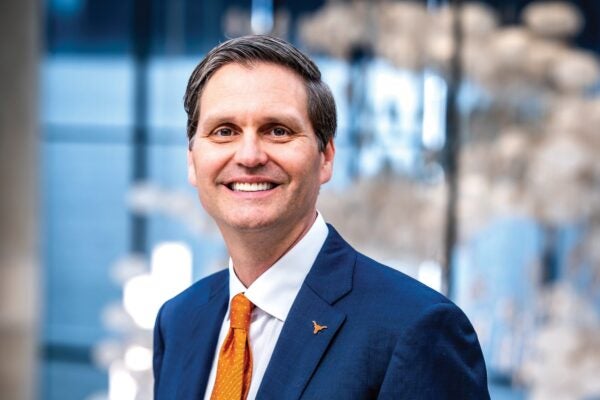
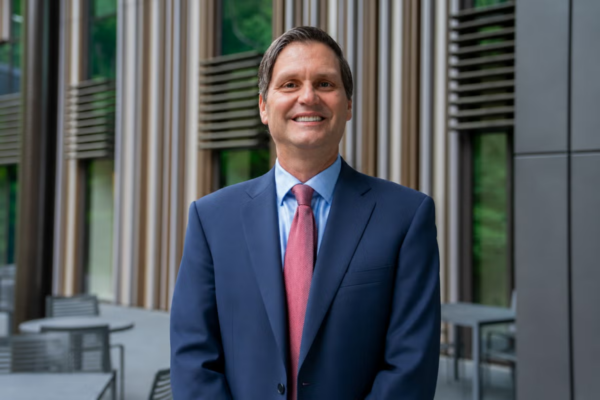
Jaime Schmidt, Professor of Accounting
When Jaime Schmidt left her Kansas City accounting firm to pursue a doctorate, she says, it was a perfect time to be doing research.
The year was 2003. Fraud at Enron, Tyco, and WorldCom had sparked Congress to pass the Sarbanes-Oxley Act, perhaps the biggest rewriting of financial reporting regulation since the 1930s.
Regulators were writing new rules, and researchers could help guide them. Schmidt, a professor of accounting at McCombs since 2009 and KPMG Centennial Fellow in Accounting, influenced one major regulation with a series of research papers about audit reports.
They reflect her conviction that academic research should have real-world consequences. “I love policy-oriented research, because we get to impact stakeholders outside of academia,” she says.
“Research exists to help organizations make better decisions, standard setters make better standards, and regulators better understand how well regulations are working.” It’s a belief that also guides her as a consultant to various outside accounting firms, law firms, and
regulators.
Improving Audit Reports
The major regulation was developed during an eight-year period by the Public Company Accounting Oversight Board (PCAOB), an organization created by the Sarbanes-Oxley Act of 2002 to regulate audits of public companies. The PCAOB’s goal was to add content to audit reports to alert investors about potential accounting issues.
Those independent audit reports, which accompany companies’ annual reports, “provide some assurance that the company’s self-reported annual report is more-or-less OK,” Schmidt says. “Without the auditor, investors could be misled.”
But under the old rules, if auditors had misgivings about a company’s practices — such as reporting overoptimistic accounting estimates — they weren’t explicitly required to
say so.
PCAOB changed that in 2017. The new rule required audit reports to disclose critical audit matters, ones that involve challenging, subjective, or complex auditor judgments.
Schmidt contributed to the regulation’s development with three papers that found some existing audit reports included explanatory language, and it was linked to higher risks of financial misstatement.
But such language didn’t significantly affect stock returns, meaning investors paid little attention.
In controlled experiments, the disclosure of critical audit matters made investors pay more attention and reduced their confidence in a company’s financial reports.
The PCAOB cited her papers in drafts and its final rule. Since the rule came out, she has published two follow-up studies examining its effectiveness.
“I had a lot of fun covering the life cycle of a major regulatory reform in auditing,” Schmidt says. “It was exciting that we could do some research to help them get to the final
version.”
AI for Accounting
More recently, Schmidt’s research has looked beyond regulation to practices in the private sector: how companies operate day to day, especially as new tools reshape the accounting profession.
She’s currently working with KPMG, a Big Four accounting firm, to measure how effectively its workers use artificial intelligence. Analyzing more than 1 million prompts that employees had fed into a large language model, she and McCombs professors Nick Hallman and Zach Kowaleski devised a metric for workers’ levels of sophistication.
“Are they using this to get one small piece of information, or are they using it for coming up with really big ideas?” she says.
Surprisingly, sophisticated users tended to be senior people rather than entry-level whiz kids. “They’re able to take their rich wisdom and knowledge of the company to make better use of the tool,” Schmidt says.
Making Data Accessible
At McCombs, Schmidt extends her impact by making research accessible to both policymakers and practitioners. That’s part of her mission as director of McCombs’ C. Aubrey Smith Center for Auditing Education and Research.
“I would like the center to be able to push out highlights of research findings in a way that more people can understand and use,” she says.
One way is through AuditChats. They’re online discussions of current issues, from methods for experimental research to private equity auditing considerations.
The virtual discussions serve an added purpose: connecting alumni. “Once students exit the University, I would like them to have a network they can tap into for advice, job opportunities, and area-specific knowledge,” Schmidt says.
By keeping research front and center, she can also benefit McCombs as an institution, ensuring its research goes on shaping how auditing is understood and practiced.
“Our mission is to ensure that The University of Texas stays No. 1 in auditing,” she says. “We want anyone interested in auditing to turn to UT Austin for thought leadership, resources, and insights into the profession.”
—Steve Brooks
Explore the stories




About this Post
Share: