From Waste to Opportunity
UT graduate turns coconut husks into a sustainable business
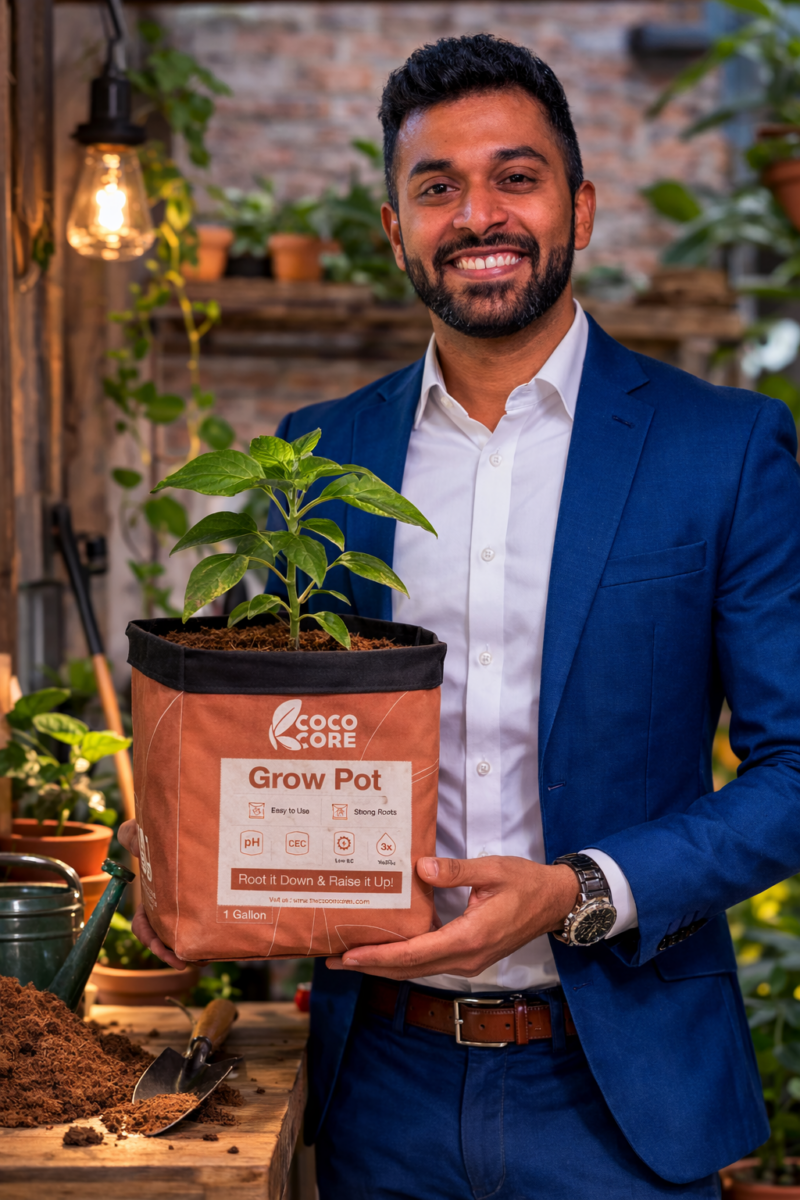
Growing up in India’s Tamil Nadu, Gowtham Velu, MBA ’26, was surrounded by agriculture long before he ever imagined building a business around it. Coming from a farming family, he saw firsthand what happened after coconuts were harvested: piles of husks were often burned or dumped because farmers had little use for them.
Years later, after earning an engineering degree from University of Southern California and spending more than a decade working in global supply chain roles at companies including Dell Technologies and Chewy, Velu found himself thinking about those husks again through the lens of sustainability and parenthood.
“When we became parents, food and where it comes from suddenly mattered more,” Velu says. “My wife and I got obsessive about ingredient labels.”
While completing an MBA at the McCombs School of Business at The University of Texas at Austin, Velu began developing Coco Core, a company that transforms discarded coconut husks into a sustainable alternative to peat moss. He says the University’s entrepreneurial ecosystem played a major role in helping the business grow.
“You’re surrounded by people building things,” Velu says. “Pitching Coco Core in those rooms forced me to sharpen the story, defend the numbers, and answer hard questions from people who weren’t going to just be polite about it.”
In November 2025, the venture earned Velu the inaugural Parekh India Impact Prize, a $10,000 seed grant created by the Global Sustainability Leadership Institute at McCombs to support student entrepreneurs addressing social and environmental challenges in India.
As Velu researched sustainable agriculture, he became interested in peat moss, a growing medium commonly used in agriculture that is harvested from peat bogs, ecosystems that take thousands of years to form. Extracting peat releases stored carbon into the atmosphere and damages ecosystems that are difficult to restore.
At the same time, Velu knew coconut farms back home in southern India were generating massive amounts of agricultural waste.
“So, you’ve got a waste product in one place and an unsustainable input in another,” he says. “Coco coir sits right in the middle. It solves both.”
Although coco coir itself is not a new material, Velu realized the larger issue was consistency. Growers who had previously used coco coir often dealt with unreliable quality and supply chain problems.
“That’s the moment it actually clicked,” Velu says. “The problem wasn’t agronomy. It was the thing I already knew how to fix.”
Coco Core begins with coconut husks collected from farms in Tamil Nadu that would otherwise be burned. The material is processed, washed, and buffered to meet agricultural standards before being compressed and shipped to growers in the United States.
Velu says the company’s impact exists on both sides of the supply chain. In India, the business creates additional income opportunities for farming communities while reducing agricultural waste. In the U.S., it offers growers an alternative to peat-based products.
“The impact isn’t a side effect of the business,” Velu says. “It’s built into the unit itself.”
Programs including SEED, Forty Acres Founders, and Fowler Global Social Innovation Challenge helped him refine the company, but Velu says the Parekh Prize remains especially meaningful because it was the company’s first major recognition.
“When you’re early, the hardest thing isn’t the work,” Velu says. “It’s not knowing whether the thing you’re pouring yourself into is actually real.”
Velu described the award as the “first yes” that gave him confidence to keep building.
“And that validation coming from India, from where I’m from, that’s something that will always be close to my heart,” he says.
For Velu, the work has become deeply personal. As a father, he says he hopes Coco Core becomes proof that small, local solutions can create meaningful change.
“I didn’t want my answer to be that I saw the problem clearly and decided it was someone else’s to fix,” Velu says. “People invested in this early. Now my job is to make that investment worth it.”
Story by Catalina Lopez
About this Post
Share: