Gardening System Startup Takes Root
Student founders learn from judges’ feedback during spring investment competition
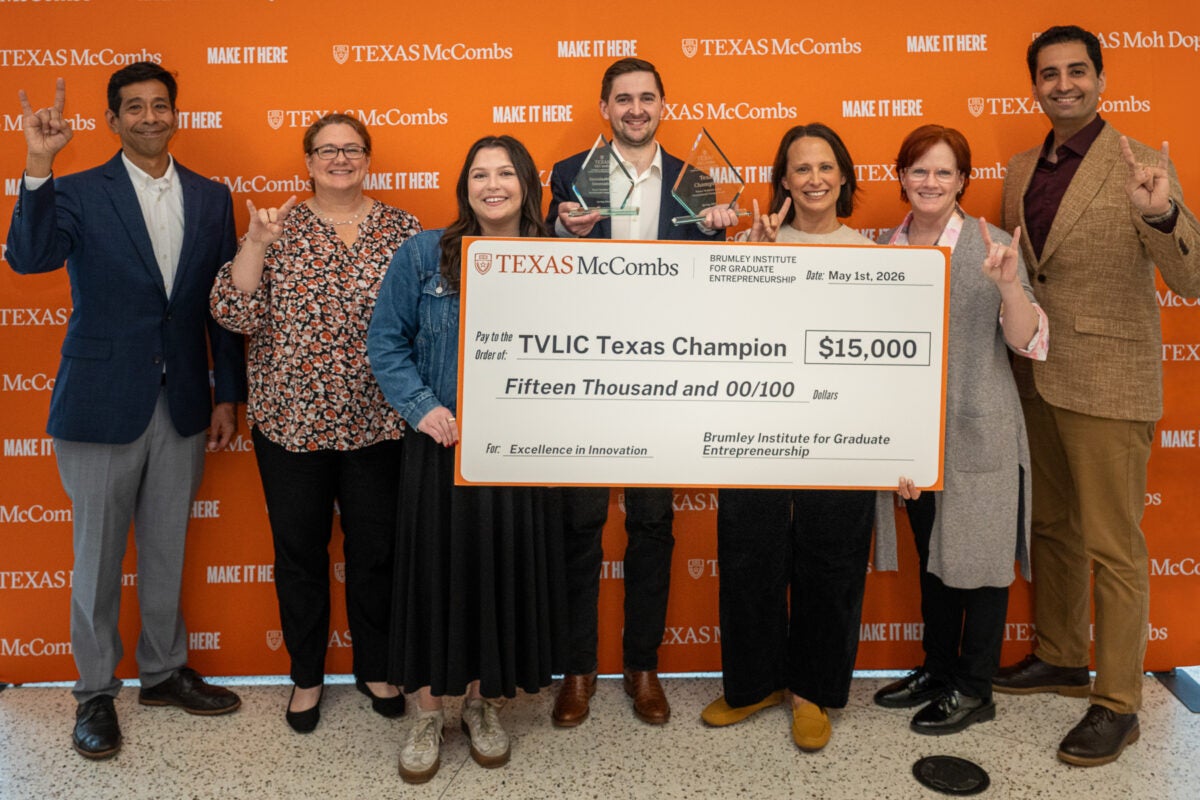
What started this year with 27 teams came down to five, and on May 1, everything was on the line at the Texas Venture Labs Investment Competition (TVLIC). In the end, Avid, an automated indoor gardening startup founded by Fred Lindseth, MBA ’26, took home the $15,000 grand prize, along with the Sustainability Innovation Award.
Hosted by the Brumley Institute for Graduate Entrepreneurship, the competition gives students the chance to present their ideas to real investors. While the prize money draws attention, program manager Christy Grady emphasized that the real value comes from the back-and-forth with judges.
“Our mission is to accelerate startups, and part of that acceleration is funding and feedback,” Grady says. “I really enjoy being able to interact with students after their first pitch. Seeing their excitement, when a judge points out something they hadn’t considered, you can tell their wheels are turning.”
The finalists pitched in front of a panel of seasoned judges, including Moonshots Capital partner Craig Cummings, Sluice AI adviser Julie Goonewardene, Toro Canyon Capital managing director Samit Varma, illumyn Impact’s Crista Bailey, and Morrison Foerster partner Shannon Sibold.
Lindseth says he spent years refining his idea through the TVL ecosystem before ultimately winning. “I was building custom indoor gardens and quickly realized people struggle with the day-to-day science — light, pH, fertilizer,” he says. “That’s when I started thinking about how to automate those harder parts while keeping the fun aspects of gardening.”
His win highlights a pattern Grady sees often. “We haven’t had a founder pitch once and win,” she notes. “It usually takes three or four attempts before they reach the top.”
The $5,000 Texas Superstar Prize and an Energy Innovation Award went to Sol-Coat, led by Moiz Mahesar, M.A. Economics ’26, and Muhammad Usama, Ph.D. ME candidate for 2028. Their product focuses on bifacial solar panels, which generate energy from both sides by capturing reflected light. It began as a class project centered on developing a reflective coating to improve their efficiency.
“We were one of the only companies that really moved beyond the classroom because the idea was so practical,” Mahesar says. For him, the competition reinforced an important lesson: “You don’t have a business until you make a sale. Before that, it’s just an idea. Our focus now is turning it into something real.”
Third-place finalist PANELS INC. brought a creative twist to the competition. Founders Jacoby Norton and Evan Brown, both MBA candidates for 2027, skipped traditional slides and instead pitched using their own storytelling software built for the Dungeons & Dragons community.
“Getting ready to present to judges really pushed us to think about how we tell our story,” Brown says. “We chose a strong beachhead — a group of highly engaged users who will keep coming back.” Norton added that demonstrating the product live helped solidify their competitive edge by showing exactly what it could do.
The remaining finalists rounded out a diverse and highly specialized group:
- ARGUS (Energy Innovation Award): Created by Nikita Yasenkov, MSTC ’26, and Santiago Callerio, Ph.D. PE candidate for 2027, this platform provides real-time operational insights for oil and gas companies to help prevent costly incidents.
- Dojo Soy Sauce (Experian Legacy Pitch Challenge Award): Founded by Chaz Zayed, MBA ’26, Dojo brings traditional Japanese brewing techniques into a modern format with a first-of-its-kind squeeze bottle.
Founders walked away with more than just prize money, Lindseth says: They left with sharper ideas, stronger pitches, and a clearer path forward. “The process is about more than winning. It’s building something that people can actually use and grow with.”
Story by Saron Yirgaalem
About this Post
Share: