Leading Forward: David Harrison
Leads the charge for bold ideas and faculty-driven research

At the McCombs School of Business, research isn’t just about publishing papers — it’s about shaping how people think about business.
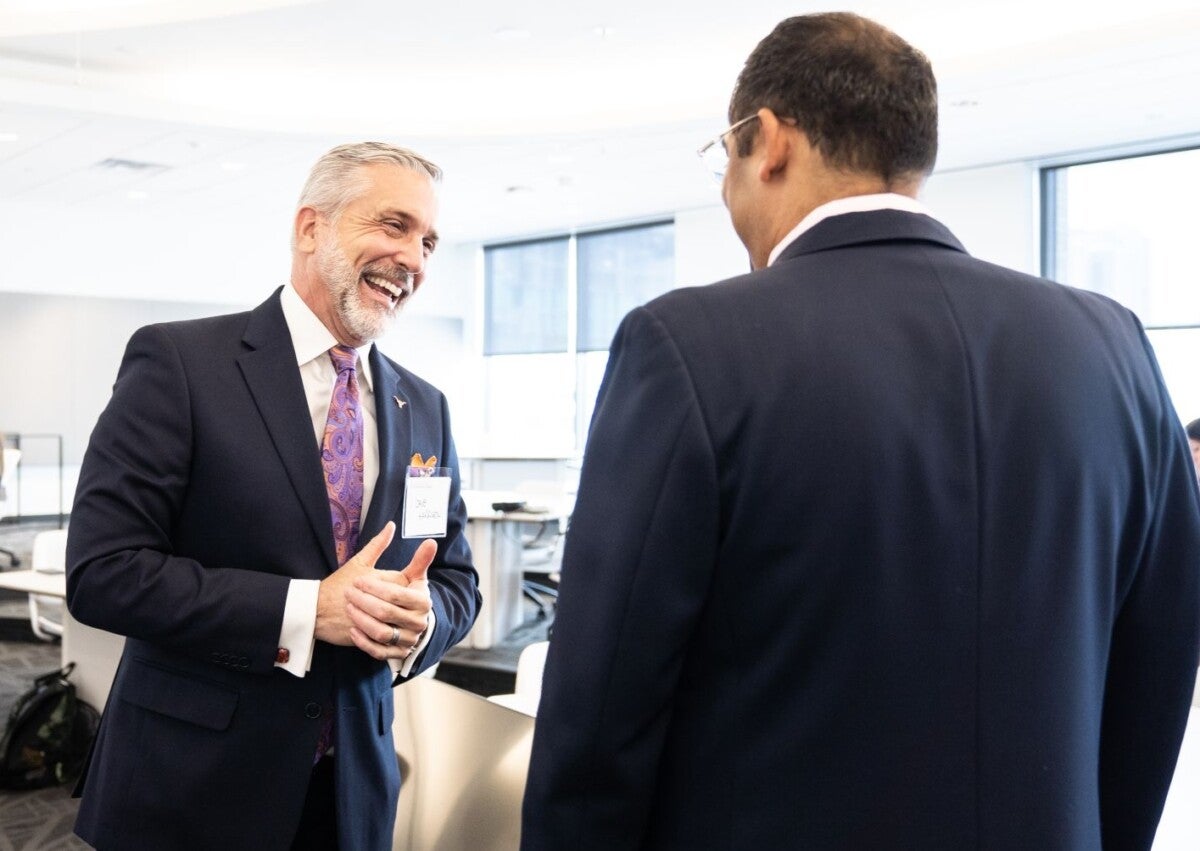
David Harrison, Associate Dean for Research, Professor of Management, and Distinguished University Chair, works closely with faculty members, Ph.D. students, and department leaders to strengthen the school’s research community and elevate the impact of McCombs scholarship.
Title: Associate Dean for Research, Professor of Management, and Distinguished University Chair
Works closely with: Faculty members, Ph.D. students, department chairs, research staff, and other UT research deans
Years at UT: 16
Hometown: Wapakoneta, Ohio (home of Neil Armstrong)
Education: B.S. ’83, Bowling Green State University; M.S. ’85, M.A. ’96, Ph.D. ’88, University of Illinois Urbana-Champaign
First job: Grocery store night stocker (unloading trucks and putting things on shelves)
Your role as associate dean for research spans many responsibilities — from supporting faculty members to shaping the school’s research agenda. What are some of the most important ways you help foster a culture of innovation and thought leadership at McCombs?
There are two main pathways of my job.
First, in the ADR’s office, we’ve raised the resource support for and the level of conversation or “buzz” around Big Ideas™ (not really a trademark — just for fun) that we propose and test here at McCombs. All the while, we’ve highlighted the joy of doing Science with a capital “S” that answers the questions we engage in the business school. In terms of resources, we’ve expanded our usable databases by nearly 40%, quintupled the number of undergraduate research assistants (URAs) we have, raised our internal grant funds by 35%, and fostered new partnerships with corporations for collecting field data. In yearslong AI project, we’ve created a push-button solution that has summarized every published paper from McCombs since around 2003, putting each into a single-page description (and slide) that is both readable and available to all students and faculty. There are now more than 2,500 such summaries that can be searched and downloaded from Canvas. All of our internal messaging about research emphasizes the importance of ground-breaking theories and rigorous investigations, but with a layer of (often pop-culture) whimsy or self-deprecation. We’ve expanded the content of our internal Research Newsletter and had 30 different faculty members write columns for it.
Second, we’ve tried to elevate the external reputation of McCombs research. Together with the McCombs marketing and communications team, we celebrate the latest publications and research awards to audiences at UT, among alumni, and with deans of other business schools. Our open rates and click rates have steadily increased and are quite high by normative standards. We’ve also encouraged faculty members to write or speak to broad audiences in ways that are universally understandable. Our faculty are very, very good at that. They also have the charm and wit to make their work attractive.
How do you help young academics at McCombs develop the skills and confidence to become thought leaders in their fields?
We’ve scheduled Faculty Friday research lunches each semester and invited students or faculty members from three different departments to each one to present their unique viewpoints on the same topic. This helps to show the coherence of the intellectual community at McCombs via shared interest domains and methodologies. More than 40 different faculty members and students have presented at those (and most of them do not overlap with the Research Newsletter column writers). A good portion of that content is geared to help doctoral students and faculty upskill in terms of new or ascending processes of doing research, particularly in the use of AI.



What advice would you give to new faculty members or Ph.D. students who want to turn their research into influential thought leadership?
As much as we think rigor is the overriding feature of publishable research, the demonstrable truth is that marketing matters as well. Choosing and framing questions, having engaging titles and introductory paragraphs, writing persuasively, and understanding how audiences process what you’re submitting are all essential skills. Oftentimes, that means simplifying what you’re doing, rather than adding complexity. Understanding how and when to focus on the novelty of one’s ideas and investigations is crucial.
- Hidden campus gem: Not really hidden, but underused — tie between Texas Science & Natural History Museum (with kids) and Blanton Museum of Art (with adults)
- Favorite Austin hangout: Butler Trail around Lady Bird Lake
- Burnt orange gear: Half a dozen or more neckties repping the burnt orange color range
About this Post
Share: