Competition Sharpens Startups for Success
Brain imaging device and routing program win top prizes at Texas Venture Labs pitch competition
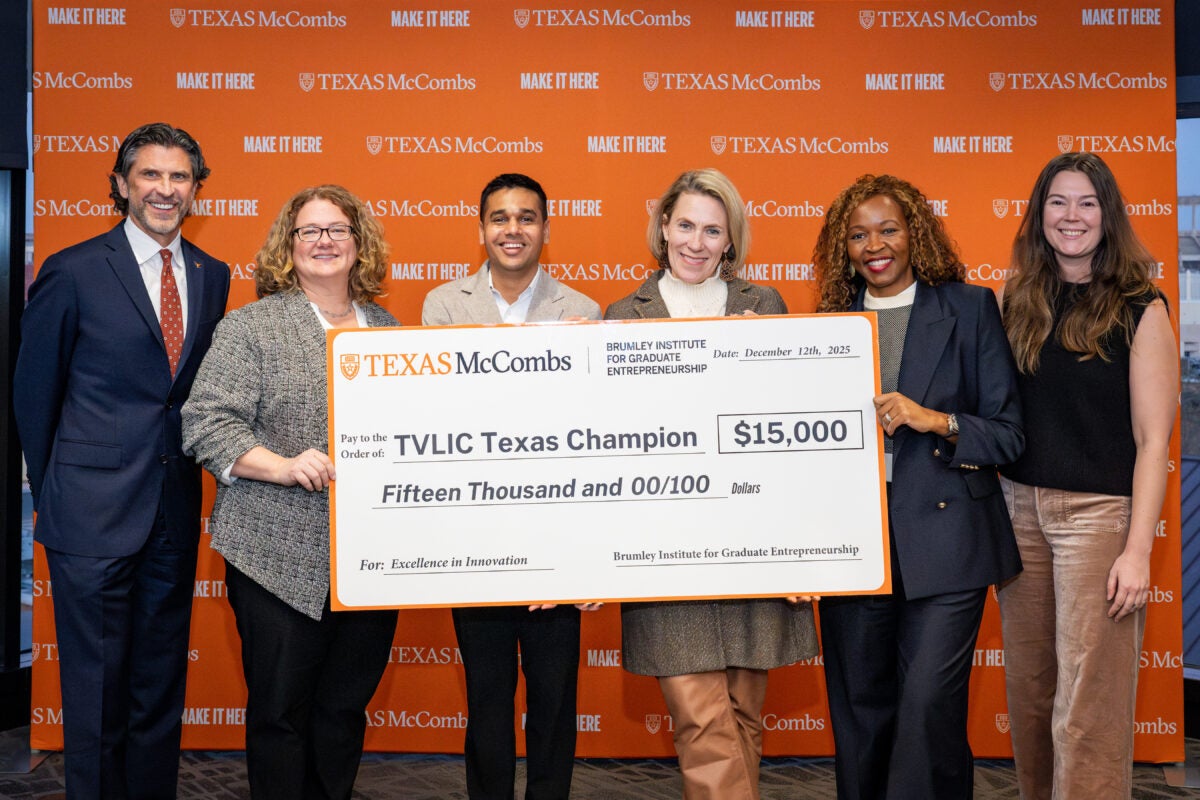
In the spirit of “What starts here changes the world,” three University of Texas at Austin startup companies took top honors at the fall Texas Venture Labs Investment Competition on Dec. 12. The winners showcased the school’s diverse entrepreneurial climate, including a brain-scanning device, an artificial intelligence-based routing and scheduling system, and a hair-braiding tool.
In the daylong contest sponsored by the Brumley Institute for Graduate Entrepreneurship at the McCombs School of Business, 27 teams of graduate students made presentations to panels of investors, entrepreneurs, and C-suite executives, totaling 52 judges.
Christy Grady, program director at the Brumley Institute, describes the event as an opportunity for UT graduate students with great business concepts to practice pitching them to investors.
“It’s a safe space for them to grow and learn and get feedback from judges,” she says. “The judges are sharing thoughts like, ‘Here’s what you should do to grow the business,’ or ‘Here’s how you should think about your pricing strategy.’”
Students get more than feedback, she adds. “A lot of the judges will say, ‘Please share my contact information.’ This is a great opportunity to connect with venture capitalists in our community.”
Besides recognition and connections, the three top companies got cash prizes, which all plan to invest in their growth.

First place, worth $15,000, went to CerebroSonic. It’s developing a helmet-style device to image brains for strokes and traumatic brain injuries, for which it estimates a potential U.S. market of $28 billion.
The process has several advantages over existing imaging, says founder Bharat Mathur, a doctoral candidate in mechanical engineering with plans to graduate this year. It doesn’t require patients to be moved from their hospital rooms, and it enables high-frequency monitoring for rapid response to changes in condition in the intensive care unit.
Mathur chose UT Austin as the best place to develop his concept, he says. “It brings a unique combination of a very strong engineering school, a very strong medical school, and one of the top three entrepreneurship ecosystems in the country.”
CerebroSonic won an additional $10,000 in the competition: the Discovery to Impact Award for Commercialization.
In second place, the Texas Superstar prize for $5,000 went to Routora, headed by Tom Vazhekatt, a student who plans to complete McCombs’ Master of Science in Technology Commercialization program this year. First developed to optimize routing for delivery workers, Routora now focuses on helping local governments route and schedule inspections — a market the company projects to be $12 billion.
In a pilot program with New York City’s Department of Buildings, the agency is projected to save more than 600 hours of manual planning time each week and conduct an added 50,000 inspections annually. At scale, the program will benefit both agencies and residents by freeing staff to conduct more inspections and address issues more quickly, Vazhekatt adds.
Awards from TVLIC and other pitch contests are part of $500,000 that he and a partner are raising. Their goal is to refine their product in New York City and expand nationwide.
In recent weeks, Vazhekatt has met with multiple potential investors who saw him at TVLIC. “The value wasn’t necessarily getting second,” he says. “It was really the exposure that this competition gave us to potential investors in the Austin area.”
The third-place award, the Texas Rising Star, went to Chisom Okwor, who expects to earn a Master of Science in Artificial Intelligence this year. Her startup, Braidiant, is creating an automatic braider for curly and coily hair. She pegs its nationwide market in hair salons at $12 billion.
Okwor, who works as a software engineer for Google Maps, got the concept from her childhood in Nigeria, where she apprenticed as a braider. The device can do in minutes what usually takes an hour, she says, while relieving strain both on the braider’s hands and on the client’s scalp.
Her prize money will go toward $325,000 she’s raising to manufacture and test 100 prototype units, as well as for patents.
She says she hopes to incorporate her AI degree into future versions, imagining “a device that can be intelligent enough to braid your hair from start to finish. And not only that, there’s also a data angle: a device that can analyze your hair and give you insights on how healthy your hair is, maybe diagnose conditions.”
Besides the top three, judges awarded several other prizes:
- Health Innovation Award, $5,000 to Pulse
- Sustainability Award, $5,000 to Pinpoint Irrigation
- Energy Innovation Award, $5,000 to Lightstack Technologies
- James D. Pippin Veteran Entrepreneurship Award, $1,000 to Chaskia
TVLIC has deep roots at McCombs, Grady says, tracing its origin back to 1984. Several past winners have gone on to develop significant Austin-area businesses, among them:
- BeatBox Beverages, which sells $340 million worth of ready-to-drink alcoholic beverages in fruit flavors. In December, it sold an 85% stake to Anheuser-Busch.
- uShip, an online platform for shipping oversized freight, which moves 690,000 shipments worth $1.4 billion a year.
- Ordoro, whose software streamlines inventory, order management, and shipping for e-commerce companies, processing $1.7 billion annually in orders.
The competition happens once each semester. Grady encourages graduate students from any school in the UT System to apply for the next one, which will happen May 1.
It’s common, she says, for startups that don’t win to return and try again. That was the case for Mathur, who took the top prize on his third try.
He advises others to keep trying. “If you are continuing to develop your business strategy, then definitely come back,” he says. “You’ll be a lot better the next time.”
Story by Steve Brooks
About this Post
Share: